The Guardline
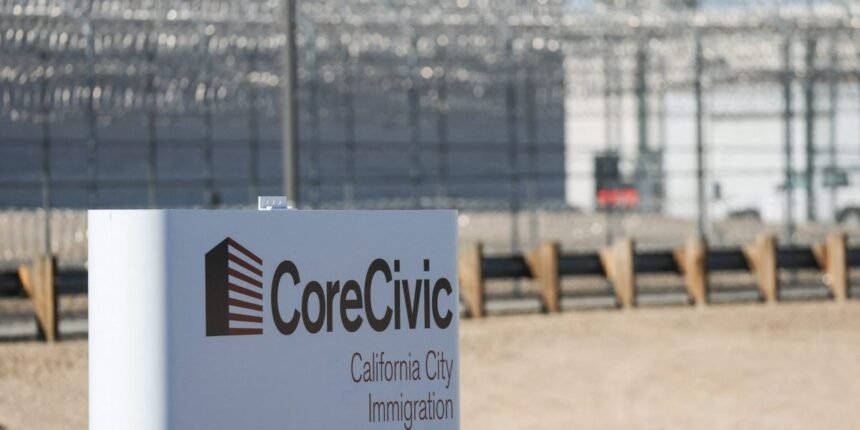
Some of the largest banks in the nation for years have eschewed the business of private prison giants like GEO Group and CoreCivic, the two firms that operate more than half the private carceral facilities in the country, including many U.S. Immigration and Customs Enforcement detention centers.
The moves to “debank” the companies, which have been dogged by reports of rights abuses, came after the banks’ reviews of their environmental, social, and governance policies, which included site visits and meeting with civil rights leaders. According to a nonprofit report, the moves by banks, including JPMorgan Chase and Wells Fargo, cost the prison companies billions in potential financing.
“Private prisons profit purely from locking people up, but the market is not immune to public accountability.”
Now, the private prison firms are fighting back, spending millions on lobbying Congress to pass a law to require that the banks can’t deny their business.
The two prison giants spent millions lobbying for legislation known as the Fair Access to Banking Act, a pending bill that seeks to prevent banks from denying access to institutions or people including those involved in “politically unpopular businesses but that are lawful under Federal law.” A press release marking the bill’s introduction last year said, “The legislation requires that lending and services decisions must be based on impartial, risk-based analysis, not political or reputational favoritism.”
Civil liberties advocates have criticized the legislation.
“Private prisons profit purely from locking people up, but the market is not immune to public accountability,” said Eunice H. Cho, a senior counsel at the American Civil Liberties Union’s National Prison Project who has represented immigration detainees housed in privately operated ICE facilities. “Consumer advocacy is a very important part of the democratic process, including economic boycott and protest against corporations. Banks are sensitive to understanding the risks of doing business with harmful industries.”
“We value the relationships we have with our financial partners,” Ryan Gustin, a spokesperson for CoreCivic, said in a statement. “We also believe all lawful businesses should be treated fairly under the banking system.”
GEO Group did not respond to a request for comment.
Millions in Lobbying
Last year, GEO Group spent $3.3 million in lobbying various departments and agencies of the federal government, of which $1.37 million was spent in lobbying the House and the Senate on issues that included the Fair Access to Banking Act, according to federal lobbying disclosures.
Meanwhile, in 2025, CoreCivic spent $3.5 million total on lobbying, of which $2 million went toward pushing for the legislation, according to the disclosures.
Despite hiring high-profile D.C. firms for their lobbying activities, both prison companies utilized their in-house government relations experts when it came to advocating for the banking legislation, which is moving through the Senate and the House.
In its fourth-quarter lobbying report, GEO Group mentions “S. 401 and H.R. 987, Fair Access to Banking Act; Issues related to the availability of banking services for federal contractors” as one of its lobbying issues. CoreCivic’s lobbying issues in the same quarter also mentioned “Issues pertaining to financial industry practices; H.R. 987/S. 401 – Fair Access to Banking Act.”
GEO Group and CoreCivic have long faced criticisms and lawsuits from rights groups for poor prison conditions, undermining medical needs of detainees, and not doing enough to prevent deaths in their facilities.
In December and January alone, for instance, five of the 11 people who died in ICE custody were housed in detention centers owned and operated by one of the firms, ICE’s press statements show. At least four people died while detained in a GEO Group facility, and one other individual died while detained in a CoreCivic center.
In 2019, JPMorgan Chase, Wells Fargo, SunTrust, BNP Paribas, Fifth Third Bancorp, PNC Bank, and Bank of America said that they would no longer provide any new financing to the private prison industry. At the time, the banks reportedly constituted more than 70 percent of the total financing available to the two companies, with many of them having loaned money to either one or both firms.
Many of these Wall Street banks took similar action against gun manufacturers, oil and gas companies, and porn sites, among other industries, in what came to be known as debanking.
The impact was considerable. CoreCivic reportedly had to scramble for finances abroad.
If the new legislation passes, however, the two companies will have access to fresh lines of credit that could help them build new facilities at a faster pace and cash in on a higher demand for ICE detention facilities.
Last July, the federal government approved funding of $45 billion to build new immigration detention centers as part of the One Big Beautiful Bill Act.
In its third-quarter earnings report, GEO Group said it had secured four ICE contracts for four new ICE detention facilities totaling about 6,000 beds. CoreCivic also reported receiving contracts for four facilities with over 7,000 beds. Financial statements suggest that the new contracts have boosted the revenue figures of both the companies, who rely heavily on federal contracts to support their bottom lines.
An Ally in Trump
The concerted effort put into lobbying by GEO and CoreCivic has already reaped some success.
President Donald Trump signed an executive order last August that empowered federal banking regulators, such as the Small Business Administration, to monitor financial institutions that denied services to clients based on “politicized or unlawful debanking action.” Last month, Trump announced he would sue JPMorgan Chase for debanking him over the January 6 riots.
In December, the Treasury Department’s Office of the Comptroller of the Currency published a report that scrutinized nine banks and listed private prisons as being among the sectors affected by debanking. The bureau said that it intends to “hold these banks accountable for any unlawful debanking activities, including by making referrals to the Attorney General.”
In June, even before Trump’s order, Bank of America, which had cut ties with private prisons, reinstated CoreCivic as its client, according to Semafor. A JPMorgan Chase spokesperson said the bank hasn’t changed its policy of freezing out private prisons. Meanwhile, most other banks have been quiet about whether they will change course on financing private prisons. (None of the banks responded to The Intercept’s requests for comment.)
If the Fair Access to Banking Act passes Congress, the banks may not have a choice.
“It has been the worst year for immigration detainees in decades,” said Cho, the ACLU lawyer. “Private prisons have an astronomical amount of funds available to them, and it’s unsurprising they are also looking to protect ways to expand those funds with extra lines of credits available. But for detainees, this can have serious implications.”