The Guardline
Speaking to a modest crowd of voters inside a Canton brewery on Tuesday evening, Mallory McMorrow, a leading candidate for Senate in the swing state of Michigan, made an anti-war appeal as President Donald Trump’s threats to kill “a whole civilization” hung over Iran and the world.
“This is a moment for people to stand up and to decide who they are actually for — are they for the Constitution, are they for Americans, are they for Michiganders, or are they for Donald Trump?” McMorrow said to applause. She encouraged Democrats to consider invoking the 25th Amendment as an option to counter Trump.
Later that evening, 17 miles to the west before a packed auditorium at the University of Michigan, McMorrow’s opponent Abdul El-Sayed also criticized the war — and a key distraction from it.
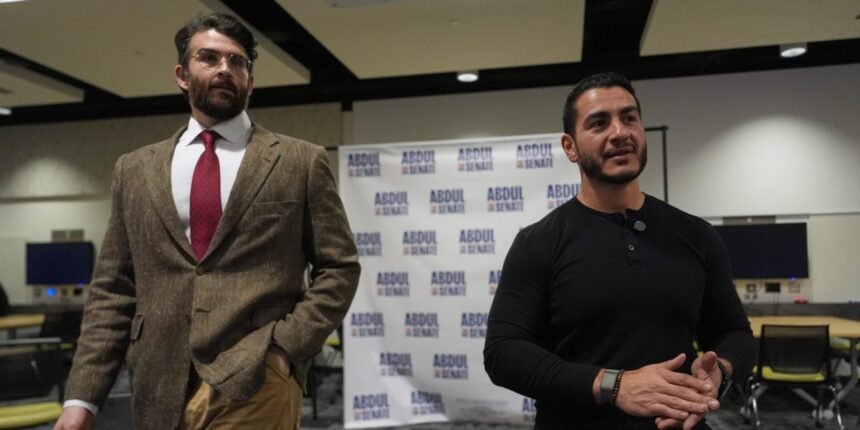
“Our president is waging a genocidal, illegal, unjustifiable war with Iran that is torching our tax dollars to the tune of $1.5 billion a day,” El-Sayed said. And yet, “apparently the most important thing happening on Twitter was whether or not we were gonna campaign with Hasan.” He was referring to the popular political streamer Hasan Piker, who stood by his side at two 600-attendee university rallies that day, the largest of any campaign events in Michigan so far this year.
The primary contest between McMorrow, a Michigan state senator, and El-Sayed, a physician and former candidate for governor, has turned into a referendum over the future of the Democratic Party and who should lead its insurgent left flank. The two are locked in a three-way race for Michigan’s Democratic Senate nomination with Rep. Haley Stevens, a moderate with establishment backing who led the polls early on but has since seen her popularity slip. McMorrow and El-Sayed have both positioned themselves as outsiders to D.C. who promise progressive policies to help Michiganders struggling in an increasingly unaffordable economy — but the finer points, like debates over appropriate language and acceptable surrogates, reveal a deeper source of uncertainty: How far left is too far for the Democrats?
How far left is too far for the Democrats?
“This is almost like a proxy fight for 2028 in the presidential election,” said Adam Carlson, a political consultant and pollster behind Zenith Research. “It’s kind of like an AOC versus ‘insert more progressive center-left politician here.’ I think that whichever side comes out victorious will claim that as a mantle.”
Michigan is a state of key presidential importance. Its voters have backed the winner in every presidential election since 2008, swinging for Trump both times he won and against him the one time he lost. The 2026 general election for Senate is poised to be a close contest between the parties, too: In retiring Democratic Sen. Gary Peters’s last election in 2020, he fended off Republican challenger John James by a slim 1.7 percent margin. Democratic Sen. Elisa Slotkin won her seat by an even slimmer margin, defeating Republican Mike Rogers by less than 1 percentage point in 2024. Rogers is running again this year.
As the Democratic Party seeks to consolidate support against Republicans, the fury over seemingly minor events like Piker’s appearance speaks to a growing gap between its establishment and the younger, more progressive part of its base. Piker, a leftist streamer who commands a massive audience in an online format often dominated by the far right, has been both held up as an essential asset for the left and shunned by centrists for his critical view of the U.S. and Israel’s role on the world stage.
Comparing Piker to the far-right, neo-Nazi podcaster Nick Fuentes, McMorrow told Jewish Insider, “That is not somebody that you should be campaigning with at a moment when there is clearly a lot of pain and trauma across our state,” a reference to a March 12 attack in which a U.S. citizen whose relatives the Israeli military killed in Lebanon rammed his car into a Michigan synagogue and opened fire before killing himself.
A McMorrow campaign staffer told The Intercept that the comments were given to Jewish Insider as a part of a longer feature story about the Temple Israel synagogue attack and her connections to the Jewish community; McMorrow’s husband and daughter are Jewish. But to El-Sayed, who released a lengthy statement decrying the synagogue attack, McMorrow’s comments revealed a disproportionate “hierarchy of pain,” in which the suffering of Jewish people matters more than that of the Arab and Muslim communities to which El-Sayed belongs. Piker, meanwhile, has objected to characterizations of his pro-Palestine politics as antisemitic.
“The south of Lebanon where a lot of communities in Michigan come from has a dire history of being destroyed by Israel,” El-Sayed said. “Israel right now is setting up to annex parts of southern Lebanon. If you have family who are dying or displaced in a war, that is deeply painful. There are a lot of people all over the state who are sad, but certainly, if you got family members who are running for cover because of Israeli bombs, you’re going to be pretty sad.”
That this ideological debate manifested in outrage over Piker — largely driven by the neoliberal think tank Third Way — suggests a fearful response from the party establishment to the surge of younger, progressive candidates, Carlson said. He sees the attacks as an attempt by the establishment to hold on to influence within the party, with the ultimate hope of sending a more moderate candidate into the presidential election.
Rallying with El-Sayed at Michigan State University, Piker criticized Democrats who spent the last several weeks attacking him rather than decrying Trump’s war on Iran, singling out McMorrow and Stevens by name, drawing boos and jeers from the crowd.
“That’s exactly what’s wrong with politics in this day and age, and that’s why all of you came here,” he said, connecting the moment to the student protests against Israel’s genocide in Gaza. “For two-and-a-half years, they smeared people like myself and people like yourselves, and said that we were radical, said that we were wrong, and yet, we persevered, and we understood the violence that was taking place.”
“Mallory is about representing everybody,” a spokesperson for her campaign told The Intercept. “There’s a way to satisfy people who do have bold, progressive visions of what it is that they want to see in terms of policy, and meeting them there and saying, ‘This is how we get to your goal.’”
This brand of progressivism has put her in a tricky position, seeking to appeal both to voters who want to see a stronger fight out of establishment figures like Stevens and those who view El-Sayed as too radical. Former Bernie Sanders speech writer and founder of The Lever David Sirota labeled her a “clickbait candidate” over a campaign ad against surveillance pricing, pointing out that she had not introduced legislation to halt the practice in the state Senate, and instead voted for tax incentives to build data centers in 2024. (The tax incentives also included environmental and consumer protection measures.)
Such debates over progressive labels may have limited significance to actual voters, experts and analysts told The Intercept.
“A lot of this division is a national Democrat division that regular voters don’t care about and/or are ignorant of,” said Corwin Smidt, a political science professor at Michigan State University.
Amanda Litman, co-founder and president of Run for Something, which backed McMorrow in her successful seat-flipping 2018 state Senate run, agreed that many people don’t vote based on ideological labels.
“This conversation about progressive versus moderate, leftist versus centrist — that’s not how most people think,” Litman said. “They think my housing is really expensive and my child care bills are really high, and why the fuck is Congress fighting about like TSA and why are the lines at the airports long? That’s where voters are.”
El-Sayed and McMorrow diverge in key areas where voters have pushed Democrats to be bolder. McMorrow has called for drastic reforms of Immigration and Customs Enforcement; El-Sayed calls for ICE’s abolition. El-Sayed is running on Medicare for All and co-wrote a book on the policy; McMorrow advocates for a public option, which her campaign said she sees as an initial step toward enacting universal health are. El-Sayed has called for ending all military aid to Israel — in line with a recent high-profile pledge made by Rep. Alexandria Ocasio-Cortez — and McMorrow has said she would halt sending offensive weapons to Israel, while maintaining other weapons, such as the Iron Dome. (Stevens has regularly voted in favor of sending weapons to Israel, called to lower Medicare costs, and pushed for ICE accountability measures.)
“My opponents each have the same policy positions,” El-Sayed told The Intercept. “One of them has better comms and more charisma. The other one has the DSCC establishment behind them.”
McMorrow’s campaign rejected the assertion that her platform is indistinguishable from Stevens, calling McMorrow’s plan a “21st century agenda to bring back the American dream and make it actually work for people.”
She has decried the application of a “political purity test” over how to describe Israel’s genocide in Gaza. El-Sayed was the first among the candidates to use the word, joining the overwhelming international consensus among human rights organizations as well as the independent United Nations commission on Palestine. McMorrow embraced the term in October but maintained, in a January radio interview, that she finds litmus testing over it unproductive. She differentiated between the genocide of Palestinians and the Holocaust, which she said, “does mean something very different and very visceral.”
“If you can’t call that what it is, a genocide, then I’m so sorry, but it’s very difficult to believe that you’re actually going to show up and do the things that you say you’re going to do,” El-Sayed told The Intercept, without mentioning McMorrow by name.
Basim Elkarra, executive director of Council on American-Islamic Relations Action, which has endorsed El-Sayed, said in places with large Middle Eastern and North African communities, especially swing states like Michigan, these issues will prove critical in elections as Israel continues its wars on Gaza, Lebanon, and Iran. The Uncommitted Movement of 2024, which motivated 13 percent of Michigan’s Democratic primary voters to cast protest votes while calling for a ceasefire in Gaza and an arms embargo on Israel, began in Michigan’s MENA community and snowballed into a national movement.
“Folks are going to have to go through these communities in order to win in Michigan,” Elkarra said, “so it doesn’t help to alienate this growing voting bloc.”
With nearly four months to go before the August primary, McMorrow is leading El-Sayed in fundraising, pulling in $3 million to his $2.25 million since the start of this year, according to their respective campaigns. The Federal Election Commission has not yet verified the figures.
Both El-Sayed and McMorrow have sworn off corporate PAC money and American Israel Public Affairs Committee support. Yet McMorrow has received criticism over a leaked call reported by Drop Site News in which a donor spoke of an “outstanding” AIPAC position paper she submitted last year, and her candidacy has become ensnared in debate over the political role of self-described progressive Zionist groups like J Street, which backs McMorrow. AIPAC, for its part, has targeted McMorrow with fundraising emails — and is supporting Stevens.
Stevens is additionally backed by the AIPAC-aligned Democratic Majority for Israel and has also received donations through a less traceable money machine known for filtering pro-Israel donations. She appeared on a donation portal on proisraelnetwork.org, which AIPAC donors have used to fund other candidates that have sworn off AIPAC support. Stevens’s support is no secret, however: She has spoken at AIPAC events and released promotional videos for the lobby group.
Stevens, who has not released her fundraising numbers for the most recent quarter, has been running largely on her resume, which includes flipping her historically red congressional district blue in 2018. She did not immediately respond to The Intercept’s request for comment.
Carlson, the pollster, thinks the more Michigan voters see of Stevens, the more support will coalesce around McMorrow and El-Sayed, leaving more space for the two to differentiate themselves. McMorrow has called for five debates before August.
Bill Lewis, a sophomore who helps run Students for Abdul at the University of Michigan, argued that El-Sayed was more captivating for young voters.
“Appealing to moderation is not always a winning strategy,” Lewis told The Intercept. “And if you go on campus and you ask people here, ‘Who are you excited for,’ they’re not saying Mallory, because that imagination, at least to me and to a lot of other people, is not there.”
Mari Manoogian, executive director of the nonprofit The Next 50, which supports Democratic candidates under the age of 50 and has endorsed McMorrow, said McMorrow and El-Sayed are already running in two distinct lanes, differentiated not just by substance, but also by style. She said while both have some populist policies, McMorrow espouses “authenticity,” while other candidate messaging “comes off as stilted and disjointed.”
Manoogian, a former Michigan state representative who also flipped her district blue in 2018 and campaigned alongside McMorrow, credited McMorrow for helping return the state’s Senate to Democratic control for the first time in 40 years in 2022, when McMorrow used the national attention from a viral speech that year to fundraise and campaign for other state candidates.
She also pushed back on the notion that McMorrow is a progressive candidate, favoring the label of “pragmatic.”
“Mallory is not focused on slogans and simplifying policy in the fewest number of words,” Manoogian said. “She’s focused on speaking to voters about something she believes she can actually deliver on.”
El-Sayed frames his criticism of Israel and U.S. foreign policy in pragmatic terms, too. At the Michigan State University rally, El-Sayed countered Islamophobic attacks against him while criticizing the war in Iran, saying he wanted to instead reinvest public funds in services for Michigan.
“A lot of people say it’s because I’m Arab or Muslim,” he said, referring to his anti-war stance. “And I say no, it’s because I’m fucking from Michigan.”