The Guardline
When the House of Representatives voted on a long-term extension of a controversial surveillance law in April, House Democratic leaders were content to let their members vote as they wished, dealing a blow to privacy advocates seeking reforms to a provision that allows domestic spying without a warrant.
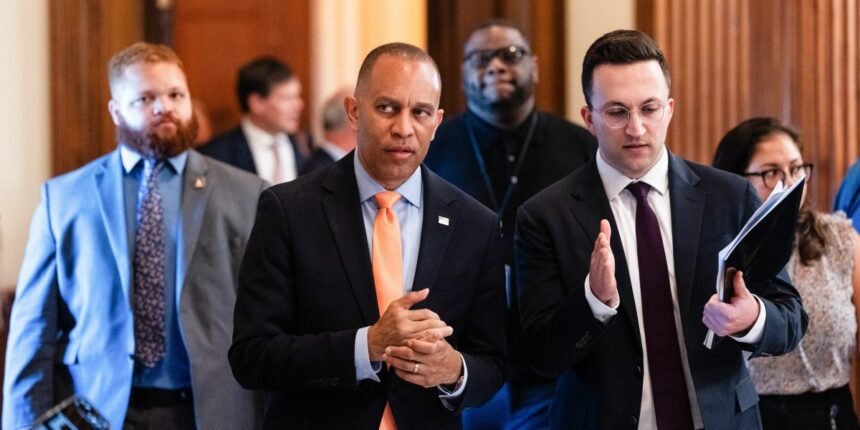
House Minority Leader Hakeem Jeffries, D-N.Y., had said he personally supported reforms, for instance, but declined to whip votes against the law.
“Voting for a clean reauthorization of Section 702 is co-signing the Trump administration’s mass surveillance agenda.”
President Donald Trump’s appointment of housing czar Bill Pulte to be the nation’s spy chief, however, appeared shore up Democratic leaders’ spines — for now.
Citing Pulte’s lack of experience and fealty to Trump, Jeffries on Thursday corralled his members into opposing a short-term extension of the law, leading to a 218–198 defeat of the measure. Democratic leaders did not issue a formal whip notice, but they did release a forceful statement against it hours before the vote was set to take place.
The different approach from leadership between the two votes was “night and day,” one Democratic staffer told The Intercept.
Dozens of the 42 Democrats who had voted for the “clean” renewal last time reversed their positions, dooming an attempt by Speaker Mike Johnson. R-La., to pass the short-term extension of Section 702 of the Foreign Intelligence Surveillance Act before it expires Friday.
The hardened line was welcomed by advocates, but in a letter penned by dozens of civil society groups they told Democrats not to flip back without changes — whether Pulte is slated to take the helm of the Office of the Director of National Intelligence or not.
Hours after the failed vote, Trump said he would nominate Jay Clayton, the U.S. attorney for the Southern District of New York, to serve as national intelligence director. Director of National Intelligence Tulsi Gabbard had resigned, saying her husband had been recently diagnosed with bone cancer, and is expected to depart on June 19.
There are bedrock policy problems with the surveillance law that go much deeper than the personnel Trump installs atop spy agencies, the groups said in the letter. They asked Democrats to block a long-term renewal of Section 702 unless it includes major reforms.
“Voting for a clean reauthorization of Section 702 is co-signing the Trump administration’s mass surveillance agenda,” the groups said in the letter. “Key administration officials — including Stephen Miller, FBI Director Kash Patel, and outgoing DNI Tulsi Gabbard — have made it clear that this reauthorization fight is a White House priority, and that reform is an unacceptable impediment to the administration’s agenda.”
The letter targeted 42 Democrats — including House Intelligence Committee Ranking Member Jim Himes, D-Conn. — who voted in April for a “clean” three-year renewal of Section 702 with only minor tweaks.
Himes was among those who, citing Trump’s appointment of Pulte to replace Gabbard, changed positions and voted against the extension Thursday.
Only Seven Holdouts
The fight over FISA has roiled Congress for months. Following the “clean” renewal’s failure and lawmakers’ inability to agree on a compromise for a longer extensions, more than 90 Democrats voted for the shorter-term postponement of Section 702’s expiration.
Since then, advocacy groups have kept up their pressure on Democrats. Thursday’s vote suggests they are making progress. Only seven Democrats voted for the short-term renewal of the law on Thursday, compared to 199 opposed. The split was reversed in the Republican caucus, with 190 votes in favor and 19 against.
The Democrats voting in favor of the short-term extension were Reps. Henry Cuellar of Texas; Donald Davis of North Carolina; Jared Golden of Maine; Vicente Gonzalez of Texas; Josh Gottheimer of New Jersey; Susie Lee of Nevada; and Marie Gluesenkamp Perez of Washington.
While the privacy advocates said reforms shouldn’t hinge on any spy official’s fate, they did say their preexisting concerns about the spying law were heightened by Trump’s appointment of Pulte and the administration’s recent release of a counterterrorism strategy calling for a crackdown on “left-wing extremists.”
“It is alarming that, under these conditions in particular, any Democratic members of Congress would vote to extend a warrantless surveillance authority for this administration to wield with no meaningful oversight,” the groups said. “The case for reforming Section 702 has never been more urgent. It is critical that you protect your constituents from the Trump administration’s mass surveillance agenda.”
The groups signing the letter Thursday — including the American Civil Liberties Union, Common Cause, and many local chapters of the organizing group Indivisible — support requiring intelligence officials to obtain judicial approval for searches of American communications.
Debates over the law, which was first passed in 2008, have occasionally flared thanks to events such as the disclosures of former National Security Agency contractor Edward Snowden and Trump’s complaints about a “deep state” intelligence conspiracy against him — though GOP opposition to the spy law dwindled with Trump taking power.
The privacy advocates, however, said they have never seen left-leaning organizers as fired up as the current round of debate over the spying law — organizing that helped precipitate the turnaround by some Democrats.
Some Democrats who were previously staunch supporters of the domestic surveillance law, such as Rep. Dan Goldman, D-N.Y., and now facing serious primary challenges voted against clean reauthorization in April, though Goldman missed Thursday’s vote.
Trump’s appointment of Pulte to serve as intelligence chief has put the law’s most fervent Democratic supporters in a bind, however, given his lack of qualifications for the job and accusations that he has wielded sensitive government databases against Trump’s opponents.
Himes, for instance, led the House Intelligence Committee’s Democrats in writing a letter to Trump calling on him to rescind his appointment of Pulte on Wednesday.
The Connecticut representative sounded exasperated in comments to Politico earlier this week. In previous fights over renewal of the surveillance law, reformers have suggested that the deadlines were artificial because of certifications from the Foreign Intelligence Surveillance Court allowing spy agencies to continue collecting overseas communications for another year.
“It’s a total mess,” Himes told the outlet. “Very sadly, I think we’re going to test this untested question about whether the program can run on a judicial certification alone.”