The Guardline
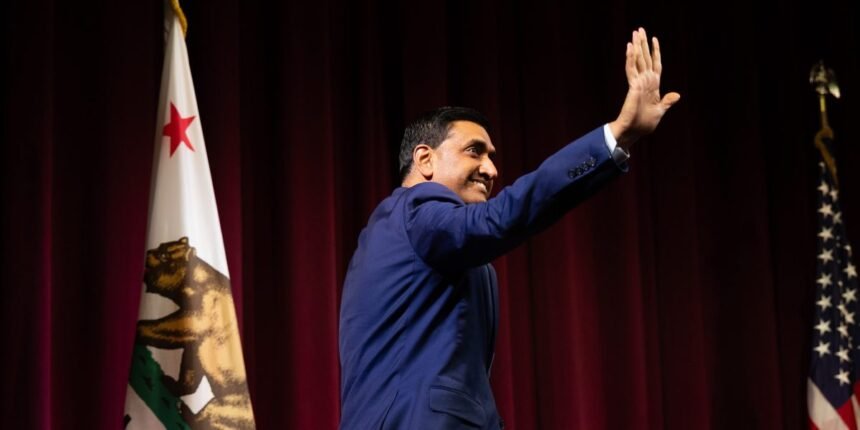
After a resounding primary victory and ahead of a potential presidential run in 2028, progressive California lawmaker Rep. Ro Khanna has received the endorsement of the influential advocacy and watchdog group TrackAIPAC, known for posting red cards of lawmakers and candidates who receive money from the pro-Israel lobby.
Khanna, a Democrat representing parts of San Francisco’s Bay Area, is the first member of Congress to go from a target of TrackAIPAC’s online fury to the winner of its endorsement. Though Khanna never took money from the pro-Israel lobby giant, the American Israel Public Affairs Committee, he received a red anti-endorsement card from TrackAIPAC in 2024 largely due to his legislative record. Khanna has taken money from the liberal Zionist group, J Street, which opposed Gaza ceasefire attempts in 2023 but has since pushed for conditions on military aid to Israel.
“Rejecting AIPAC money isn’t enough — every member of Congress must be clear on these issues.”
Khanna’s TrackAIPAC endorsement, first reported by The Intercept, came after the lawmaker on June 10 became the initial signatory of a new pledge from TrackAIPAC called PEACE, the pledge to enforce American law, counter foreign influence and end war crimes. Among other commitments, candidates who sign the pledge swear off money from AIPAC and aligned groups, acknowledge Israel’s genocide in Gaza, oppose military aid to any country that commits human rights violations, and agree to stand against efforts in Congress to emmesh the U.S. and Israeli militaries.
“I’m proud to be the first member of Congress to sign the PEACE Pledge to reject campaign contributions and political support from AIPAC, DMFI, and other groups that promote unconditional support for Israel,” Khanna told The Intercept in a statement. “The pledge also affirms my opposition to the genocide in Gaza and my commitment to voting against future military assistance to any country whose security forces are committing human rights violations. Rejecting AIPAC money isn’t enough — every member of Congress must be clear on these issues.”
With the endorsement and the new pledge, TrackAIPAC is flexing its growing influence on the Capitol. Its viral social media posts have played a large role in making AIPAC into a politically toxic entity, helping drive underground much of its campaign giving in the midterms. Those posts have also compelled lawmakers, including Khanna, to seek meetings with the group in hopes of removing their red cards. With its political arm, Citizens Against AIPAC Corruption, TrackAIPAC has also been endorsing and funding candidates.
TrackAIPAC’s founders said they want to offer a good-faith offramp for members of congress looking to evolve on Israel and Palestine. Beyond tracking the pro-Israel lobby’s political spending, the group also serves as an advocacy organization pushing for Palestinian rights in the Capitol. It has claimed major midterm primary victories in races it has endorsed a candidate, such as in New Jersey with the victory Adam Hamawy, a former Army surgeon who volunteered in Gaza during the war, Chris Rabb in Pennsylvania and Mai Vang in California.
“We’ve been really effective at building a megaphone and bringing accountability to folks who are on the wrong side,” TrackAIPAC co-founder Casey Kennedy, told The Intercept. “But with that success we’ve had, now we have a responsibility to offer a bridge to folks to chart a new path forward.”
The group has attracted controversy over its methodology, which examines campaign financing as well as lawmakers’ legislative record on policies relating to Israel and Palestine. TrackAIPAC has at times assigned its red card to lawmakers who do not take AIPAC money, which critics have called unnecessarily confusing or misleading.
Last June, Khanna became the first lawmaker to meet with TrackAIPAC, according to the group, and asked why TrackAIPAC had initially assigned him a red card. By the time they met, the group had removed the red card but did not grant him its green seal of approval. Instead, it appended a label that remains on his page today stating: “We encourage this representative to continue improving their legislative record on Israel-Palestine issues.”
In contrast, Squad member Rep. Alexandria Ocasio-Cortez, D-N.Y. has a green card and a positive label stating: “This candidate rejects Israel lobby contributions. This representative has a strong legislative record on Israel-Palestine issues.”
Khanna had previously appealed to TrackAIPAC on social media, doubling down on his rejection of AIPAC support. The posts drew the ire of AIPAC, which relentlessly attacked him on social media, at times using TrackAIPAC’s own red card graphic.
Khanna’s stances on Israel and Palestine have shifted in recent years. In the immediate weeks after October 7, 2023, Khanna voted in favor of a string of pro-Israel House resolutions, including reaffirming Israel’s “right to self-defense” on October 25. A week later, he signed a resolution that condemned antisemitism and “the support of Hamas, Hezbollah, and other terrorist organizations” in colleges and universities. Khanna was also notably absent on early resolutions calling for a ceasefire.
Khanna has since become a loud critic of Israel and has voted against a bill that sought to codify the International Holocaust Remembrance Alliance definition of antisemitism, which has been used to silence criticism of Israel. In the summer of 2025, he cosponsored the Block the Bombs bill and signed on to a pair of resolutions by Rep. Rashida Tlaib, D-Mich., acknowledging Israel’s offensive in Gaza as a genocide and recognizing the Nakba. Earlier this month, Khanna attempted to strike a portion of the National Defense Authorization Act that would codify Israel’s joint development of weapons with the U.S.
It was also this month when Khanna’s office reached out again to TrackAIPAC to revisit the possibility of gaining the group’s endorsement, the group said. His office had been receiving inquiries about his “continue improving” label on TrackAIPAC’s presidential candidate list. At the time, TrackAIPAC had already been developing its pledge and offered it to Khanna’s office.
“Groups like AIPAC are pouring money into our elections and are influencing policies that undermine human rights,” Khanna told The Intercept in a statement. “When Track AIPAC offered, I was proud to sign the pledge.”
While Khanna has not formally announced a run for president, he is positioning himself to the left of the Democratic establishment on Israel. In April, he announced he supports the halt of both offensive and so-called defensive weapons to the country due to its human rights abuses.
Adam Carlson, a political consultant and pollster behind Zenith Research, who has been critical of TrackAIPAC’s methodology in the past, has said he expects other congressional and presidential candidates courting the left to sign on to the new TrackAIPAC pledge. But he doesn’t expect a shift from the kinds of establishment Democrats often in the crosshairs of TrackAIPAC over their support for Israel.
“It’s a flex – the more people they get to sign this pledge, the stronger they are,” Carlson said of TrackAIPAC, “But it won’t change the dynamic broadly.”
He cautioned of potential pitfalls, such as how the group will hold legislators who sign the pledge accountable and warned of the risk of purity tests on the left that could hurt certain candidates’ election chances in swing districts.
TrackAIPAC said anyone who abandons the pledge would again receive a red graphic and be targeted in the group’s intense social media campaigns. Cori Archibald, TrackAIPAC co-founder, also resisted the premise of a purity test. “If you’re gonna have a litmus test,” Archibald said, “I think genocide is certainly a good one.”