
The Guardline
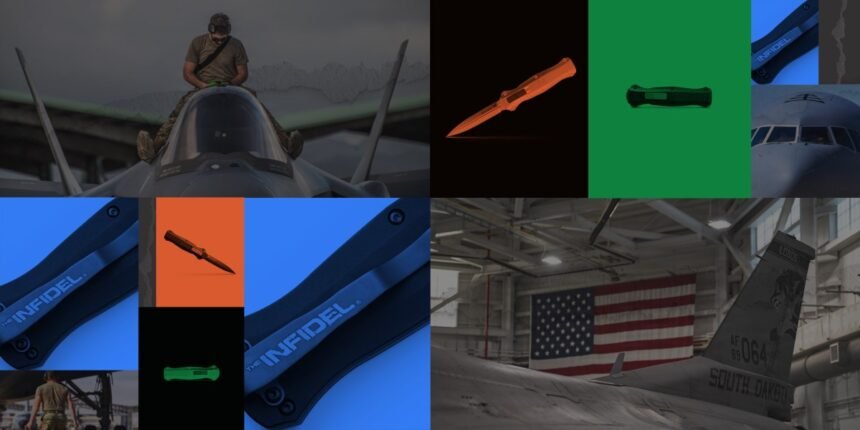
They call them “box cutters,” but everyone on the flightline knows what the term really means. The blades slide out at the push of a button, revealing high-end knives made and marketed for active combat. They cost the federal government hundreds of dollars each — and come free to maintenance workers in the Air Force who order them through the supply system and hand them out as favors.
For nearly a decade, Air Force maintenance units spent more than $1.79 million in taxpayer funds buying 5,166 high-end knives and other luxury items, including switchblades and combat-style tactical knives with no legitimate maintenance use, The Intercept has found. It’s a drop in the bucket of a U.S. military budget creeping ever closer to a trillion dollars, about $300 billion of which belongs to the Air Force. But with a military budget so bloated, the knife-ordering frenzy illustrates how obviously frivolous spending can go unchecked.
“Everyone knew we didn’t need them,” said a former noncommissioned officer recently honorably discharged from Hill Air Force Base. “There was literally zero justification in any maintenance field.”
“There was literally zero justification in any maintenance field.”
The Benchmade Infidel and Mini Infidel, the most popular choices, are sleek and black, with automatic blades that slide straight out the front. Their presence on the flightline, where maintainers work to repair and tune up airplanes between flights, is difficult to justify — and often outright banned. Procurement records obtained via Freedom of Information Act requests show that Air Force maintenance units have been buying the knives as far back as at least 2017 and as recently as June 2025, spanning multiple major commands.
Accounting for roughly a quarter of troops in the Air Force, maintainers are the technicians and mechanics responsible for upkeep of approximately 5,000 planes. They’re chronically understaffed and overworked, as The Intercept previously reported, and maintainers spanning nine bases and major commands said that some of the crucial supplies they need for maintenance — like safety wire, specialized hydraulic fluids, and calibrated test equipment — are difficult to obtain. Maintainers said that while essential tools and materials were often delayed or unavailable, nonessential items like high-end knives moved easily through the supply system, likely due to an apparent misclassification, as a procurement expert explained to The Intercept.
“It always felt like we were just putting duct tape on these jets to keep them flying,” said an active-duty senior airman who previously served in the 57th Maintenance Wing at Nellis Air Force Base. “Jets would come back with the same broken parts or worse, just so we could meet flight numbers. We never had money for proper tools, but there would be brand-new computers, unit flags, or other items to make the unit look better.”
For some maintainers, the option to order a shiny combat knife for free is something of a silver lining. “This is one of the only good things that maintainers get,” said a former maintainer from Edwards Air Force Base.
In other cases, the knives were markers of inclusion. “Tech sergeants would come in for a short time and get a knife as a welcome present,” said the former maintainer from Hill.
Nine current and former Air Force maintainers who spoke to The Intercept for this story were granted anonymity because they feared retaliation. As is common in the military, maintainers who raise concerns about excessive spending can face ostracization or professional consequences.
“It wasn’t like higher-ups would be mad if they caught you,” said the source from Hill. “They had knives too.”
“Supply Could Hook Them Up”
“We were told that if you wanted one, all you had to do was be friends with people attached to the supply line,” said a source who worked in the backshop at Nellis. “I knew plenty of people who would do favors for supply troops to get their hands on a knife.”
Six people stationed at Nellis between 2017 and 2024 confirmed that misuse of the supply system was common. One source said they still have six Benchmade knives, gifted by a noncommissioned officer in the 57th Wing. The source said they were never told how those knives were obtained.
More than 59 active-duty Air Force bases in the United States and numerous overseas installations operate under the same supply system. The Intercept submitted requests for procurement data to 28 Air Force bases and received responsive records from 12 installations. Every base that returned records showed similar knife-ordering patterns across its flightline maintenance units.
“Most things were done with handshakes, winks and nods. Definitely a good ol’ boys club,” said Micah Templin, a former weapons troop in the 57th Maintenance Wing at Nellis. “There were quid pro quos and IOUs. If you did someone a favor one day, maybe your chief or leadership would feel comfortable looking the other way on another.”
“This is one of the only good things that maintainers get.”
Sources from U.S. Air Force units in the continental United States, South Korea, and Germany said personnel routinely used the term “box cutters” as a euphemism for the knives. This made them sound simple and practical, several maintainers said, while the knives themselves were prized largely for their appearance, retail price, and the status of owning one rather than any maintenance-related use. Maintainers interviewed by The Intercept said the knives were popular largely because they “look cool.”
While Defense Logistics Agency records show how many knives were purchased overall, FOIA responses from individual bases offer only a partial picture of where those orders originated. But every installation that did provide records showed recognizable patterns, suggesting the practice was not limited to a single base or command.
Several maintainers said they believed leadership used unit funds to purchase high-end items that were later diverted for personal use, describing a culture in which “nothing was given out without a take.” Maintainers said those who resisted or questioned practices could find themselves scrutinized or under extra pressure, which discouraged reporting and allowed misuse of the supply system to continue unchecked.
“I feel like maintainer leadership will legally do everything they can to keep someone from speaking out and do anything to protect their careers. That’s the trend within senior leadership in maintenance,” the backshop source said.
Seven sources from domestic and overseas units said this often means senior enlisted personnel direct junior troops to place orders, move items, or handle deliveries on their behalf. For those with access, it’s easy to order items with minimal oversight. The practice, sources said, allowed leadership to benefit from questionable purchases while shielding themselves from scrutiny and leaving lower-ranking airmen exposed to potential disciplinary or legal consequences.
“A tech sergeant ordered a ton of Yeti coolers and then told me to load them directly into his private vehicle.”
Knives were the most common example of the misspending, but maintainers described similar practices involving other high-end items. Five airmen who served in the 64th Aggressor Squadron’s maintenance units at Nellis Air Force Base between 2018 and 2020 said senior noncommissioned officers in the squadron’s Combat Oriented Supply Organization routinely ordered new flat-screen televisions for maintenance spaces, then placed the fully functional replaced sets into unit storage areas. According to the airmen, senior noncommissioned officers later removed some of the televisions from unit spaces for personal use.
“I remember a time when a tech sergeant ordered a ton of Yeti coolers and then told me to load them directly into his private vehicle,” said an active-duty avionics troop stationed in Europe, granted anonymity for fear of retaliation. “It was always ordered in ones and twos. Anything else would raise too much suspicion.”
According to Dallas Sharrah, a former staff sergeant who served at Nellis Air Force Base: “People were mainly ordering switchblades or Oakley sunglasses for their buddies. Supply could hook them up a bit before they got yelled at.”
Costly Debris
Outside of toolkits, knives are never allowed on the flightline. They’re considered Foreign Object Debris, according to former maintenance officers, meaning they’re at risk of being sucked into an aircraft intake and damaging the engine.
The Air Force Materiel Management Handbook says that all orders must be justified for official use, but classification issues in the procurement catalog blurred the lines that define what qualifies. The knives are broadly available through standard supply channels, making repeated or bulk orders easy to place. At Nellis, purchases often averaged 20 knives per order, with some as high as 47.
“In the aggregate, someone had to be doing an audit somewhere and said to themselves, ‘Why did we order so many knives? Why are those requisitions restricted to certain bases and certain units? What is going on here?’ Clearly, no one was looking,” said Steve Leonard, a retired senior military strategist, procurement expert, and professor at the University of Kansas.
The procurement catalog is divided into subsections, Leonard explained, and knives were listed as Class IX, a category shared with maintenance-related items. But in his view, the knives should have been considered Class II items, which are intended for individual issue and subject to stricter justification, approval, and accountability requirements.
“Clearly, no one was looking.”
Items classified as Class II are typically restricted from purchase with unit funds if they primarily benefit individuals, while Class IX repair parts move through maintenance supply channels with far less scrutiny. “Most people aren’t interested in stealing hydraulic valves,” he said.
Defense Logistics Agency procurement records show the knives carry a “J” security code, meaning they are treated as security-related items rather than maintenance equipment, a designation that undermines their classification as routine repair parts.
When asked about the findings, an Air Force spokesperson did not address specific allegations or installations. The Intercept provided the Department of the Air Force with FOIA records, national stock numbers, and other evidence of more than $1 million in suspect knife purchases across six installations.
“The Department of the Air Force takes all allegations of fraud seriously and has processes and procedures in place to investigate them,” the spokesperson wrote in response. “If service members or citizens have concerns or evidence of specific wrongdoing, they are encouraged to report the information to local law enforcement or their Office of Special Investigation.”
Benchmade, the manufacturer of the Infidel and Mini Infidel knives most named in procurement records and troop testimonies, declined to comment.
Limited Oversight
It remains unclear how many knives airmen have obtained in recent months. On June 9, 2025, The Intercept submitted FOIA requests to 28 Air Force bases. Twelve installations provided responsive procurement records, while the remaining bases delayed, obstructed, or did not meaningfully respond.
At Hill Air Force Base, officials falsely claimed records from another installation were their own. Davis–Monthan Air Force Base admitted it had gone months with no staff to process FOIA requests. Joint Base San Antonio–Randolph reported spending only 30 minutes searching eight years of procurement records before declaring no knife purchases existed. At Luke Air Force Base, an officer sent conflicting messages about whether a request had been received, then attempted to delete an earlier acknowledgment email.
Air Force spokesperson Ann Stefanek said she had not previously been aware of the purchases or inconsistencies in the bases’ FOIA replies. “I am literally trying to understand what to look for and who to ask,” she wrote in an email.
The Defense Department’s inspector general system, responsible for oversight of potential fraud and other misconduct, declined to comment on the knife purchases. An inspector general spokesperson said the office does not comment on active investigations and would not say whether any investigation related to the purchases was underway. The IG system is undergoing a major overhaul, with many positions open under the second Trump administration.
At the same time, Air Force inspector general complaint records obtained by The Intercept through FOIA requests show that from January 2016 through December 2022, maintenance and munitions units at Nellis Air Force Base generated at least 274 complaints. The allegations included abuse of authority, reprisal, potential contracting fraud, and hostile work environments.
Many of the complaints were recorded as “assisted” or closed within days, averaging roughly three complaints per month over six years from the same units later tied to irregular knife purchases documented in this reporting.
Scott Amey, general counsel at the Project on Government Oversight, a nonpartisan watchdog, said the pattern reflects broader concerns about misuse of government funds and poor oversight. “While every instance might not be fraudulent, I’ll expect many of the knives purchased are for personal use with taxpayers picking up the tab,” he said. “Wasted money and unauthorized use is a bad mix, and only the tip of the iceberg.”
At Moody Air Force Base in Georgia, FOIA-obtained records describe a “recurring problem with physical location and quantity consistency” of supply items and note that “thievery is not out of question.” As a corrective step, the documents say leadership submitted an unfunded request for surveillance cameras through the procurement system.