
The Guardline
U.S. Customs and Border Protection is set to order a vast arsenal of chemical grenades, sprays, projectiles, and other weapons, according to procurement materials reviewed by The Intercept. The purchase follows months of abuse of these very munitions on American streets.
CBP will spend up to $50 million on what it refers to as “Less Lethal Specialty Munitions,” a euphemism for weapons intended to merely hurt or disable a target rather than killing them. The agency is looking for a vendor who can supply vast quantities of 123 different types of munitions across 10 different categories, the contracting document says.
“When there’s so many different kinds, it makes you question, tactically, what’s the goal there?”
“The sheer quantity and the myriad different weapons is the most remarkable thing to me,” Rohini Haar, an emergency physician and researcher of less lethal ordnance told The Intercept. “When there’s so many different kinds, it makes you question, tactically, what’s the goal there?”
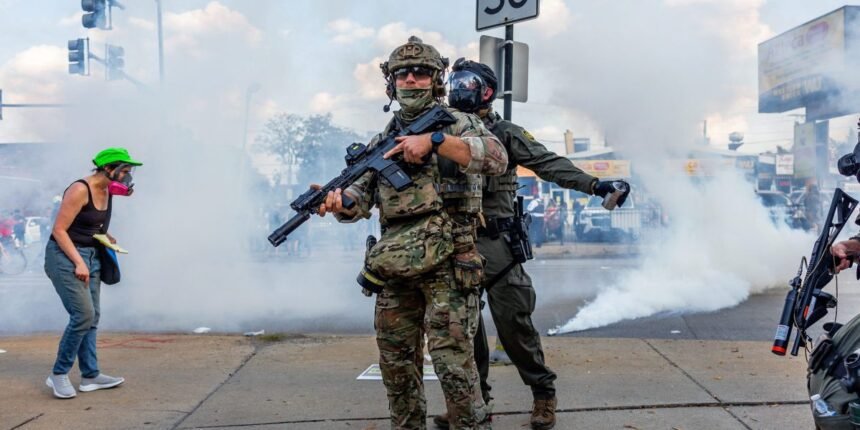
Federal agents’ indiscriminate use of “less-lethal” chemical weapons against the nonviolent demonstrators became a hallmark of the Trump administration’s immigration crackdown. Contract documents show the Department of Homeland Security will continue to stockpile a massive arsenal of tear gases and projectile weapons. (Neither CBP nor its parent agency, the Department of Homeland Security, immediately responded to requests for comment.)
Haar questioned whether the Department of Homeland Security will be able to suitably train federal agents to use such a wide variety of weapons.
“Each of them has a different sort of technical spec or specifications,” she explained. “Some of them are handheld grenades that you have to know to throw, but not hit people’s heads. Some of them are fired from a weapon, like a launcher, and so you have to be standing farther away than you would be with a grenade.”
Two Tear Gases
The shopping list includes a litany of different ways to hit people and objects with two common types of tear gas: chlorobenzalmalononitrile, or CS, a chemical weapon previously used by the U.S. in Vietnam but now banned for military use, and oleoresin capsicum, or OC, derived from chili peppers.
CBP agents already regularly use CS and OC-based weapons in the field, including against protesters. The procurement document shows that armed federal officers will continue to wield the threat of chemical agents against the public despite ample documentation of misuse.
Some of CBP’s desired weapons are designed to spread these chemical weapons indiscriminately. Included on the wish list are quart containers of liquid CS and OC meant to be spread through thermal “foggers,” dispersal devices meant to create mists with microscopic droplets of liquid. Defense Technology, a longtime chemical weapons vendor for CBP and U.S. Customs and Immigration Enforcement, says its Golden Eagle Pepper Fogger Generator can output 100,000 cubic feet of tear gas in 26 seconds.
Both chemicals are potent chemicals that can cause health effects far beyond debilitating pain.
“Greater exposure to chemical agents,” a 2023 study by the University of Minnesota School of Public Health found, “was significantly associated with higher odds of an adverse reproductive health outcomes.”
The outcomes included “uterine cramping, early menstrual bleeding, breast tenderness and delayed menstrual bleeding.”
The procurement list includes smoke grenades in four different colors and 12 different varieties of tear-gas grenades.
The weapons will be ordered in enormous volumes. CBP projects purchasing over 242,000 munitions from the “Hand Delivered Pyrotechnic Canisters” category and over 100,000 rounds of “impact munitions” fired from grenade launcher-style tubes.
The latter category includes foam-tipped “sponge cartridge” ammunition designed to either release a tear gas-style chemical upon hitting someone or merely harm them through sheer force of impact.
Maimed, Deafened, Blinded
Fired at close enough range, so-called less lethal rounds can easily kill or maim their target.
Anti-ICE demonstrator Kaden Rummler lost sight in his left eye after he was shot in the face by a federal officer in January. After the Los Angeles Police Department fired one such round directly into the face of another protester last summer, he was injured so seriously that he required surgery and had his jaw wired shut for six weeks.
“Distraction devices,” which emit loud sounds, bright lights, or other effects to stun targets, were also on CBP’s wish list, with plans to purchase 13,000 of them. The procurement document required the weapons be capable of emitting a sound of 175 decibels, louder than a gunshot or jet engine. The National Hearing Conservation Association warns of sound of 140 decibels can case permanent damage and “death of hearing tissue” begins at 180 decibels.
“In addition to injuries caused directly by the primary blast wave, such as ear-drum rupture or lung injury, secondary and tertiary injuries can also occur as a result of these explosive devices,” says a 2023 publication by Physicians for Human Rights that was co-authored by Haar.
CBP’s inclusion of rubber-ball grenades and scattershot projectiles alarmed Scott Reynhout, a researcher who also co-authored the PHR paper. When such grenades are thrown or launched at people, they release a burst of small rubber fragments akin to shrapnel in every direction and can be configured to simultaneously release tear gas.
“The procurement of the latter weapons is worrying as these have not seen widespread use yet by CBP/ICE in protests,” said Reynhout, referring to the scattershot projectiles, which he said were akin to “rubber buckshot.”
Such weapons were used by Chilean security forces against protesters six years ago, he said, resulting in more than 400 cases of partial or full-blindness, and are also employed extensively by Iranian police and paramilitaries in their crackdowns on demonstrations.
“If it can go through glass, particle board, and walls, it can go through a body.”
Weapons designed to pierce building materials were also included in the wish list.
CBP plans to purchase over 12,000 “ferret rounds,” projectiles filled with powdered or liquified chemicals that punch through barriers and spread tear gas on the other side.
Haar said, “If it can go through glass, particle board, and walls, it can go through a body.”