
The Guardline


Lauren Harper is Freedom of the Press Foundation’s first Daniel Ellsberg Chair on Government Secrecy.
President Donald Trump recently threatened genocide as political leverage on social media, which begs the question whether there are even more extreme conversations happening in private in the Oval Office, or if anyone in Trump’s orbit is cautioning him against this immoral threat of mass violence.
Access to these discussions is critical not only for accountability, but also for future administrations who want to re-engage in rational diplomacy. That’s why the Department of Justice’s recent opinion that grants Trump, and every president who follows him, a license to steal American history is so dangerous.
In a sweeping new memorandum from the Office of Legal Counsel, the DOJ claims the Presidential Records Act is unconstitutional. The department’s edict, which is already facing legal challenges, argues that a president’s records are private, rather than public, property. This is an extreme reinterpretation of executive power that seeks to undo nearly 50 years of transparency.
The PRA was signed into law after the abuses of the Watergate era and established that the records of every president since Ronald Reagan are public property and must be turned over to the National Archives and Records Administration, or NARA, at the end of a president’s term.
This law is the reason the public has insight into the inner workings of everything from President Barack Obama’s nuclear deal with Iran and the George W. Bush administration’s response to Hurricane Katrina to records on the nomination of Justices Sonia Sotomayor, Brett Kavanaugh, and other Supreme Court nominees.
That’s because the PRA states that, starting five years after the end of a presidential administration, those records become subject to public release under the Freedom of Information Act.
This history-killer memo attempts to undo this route for public access to presidential records and build a brick wall where there once was a window into the highest office in the land.

By declaring the PRA unconstitutional, the Justice Department is effectively claiming that the presidency has private ownership over the American story.
The timing of this memo adds insult to injury. Just days before its release, Trump’s son Eric unveiled renderings of a “Trump Presidential Library” skyscraper in Miami, which appears to be designed primarily to solicit private investment for the president’s personal foundation. News outlets parroted this branding, even though there’s no indication the Trump foundation will work with NARA to build a proper library. So while there may be a building where the public can go to gaze at a gold statue of Trump, it’s not clear there will be a physical place for journalists and others to file declassification requests and research his administration.
It’s no surprise that a president who spent his first term repeatedly violating the PRA now wants to eviscerate it. But the danger to our democracy cannot be overstated: The president’s decisions are the most consequential in government, and the PRA is the only reason we have a front-row seat to them, even belatedly.
At Freedom of the Press Foundation, we know what is at stake. We have filed more than a dozen FOIA requests for key records from the first Trump term that are currently held at the digital Trump Presidential Library run by NARA (not to be confused with whatever monstrosity is being built in Florida). These include:
- A copy of the Senate’s 2014 report on the CIA’s torture program, which the Trump administration helped keep secret in 2017.
- Records concerning election integrity, voter fraud, the certification of the Electoral College, and the events of January 6, 2021.
- Documents about the violent clearing of protesters from Lafayette Square in Washington, D.C., on June 1, 2020.
- Communications documenting Trump’s reaction to the 2019 and 2021 impeachment proceedings.
- Memorandums of conversation with foreign leaders, including Vladimir Putin and Kim Jong Un, as well as written correspondence, such as Trump’s “love letters” with the North Korean leader.
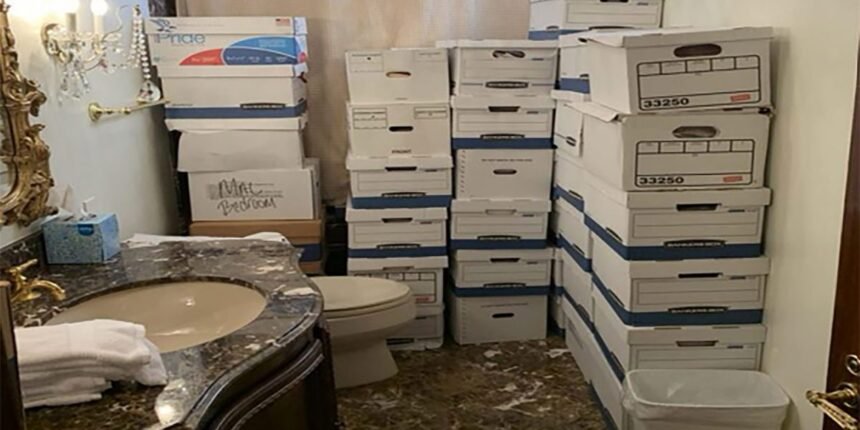
If the DOJ succeeds in claiming presidential records are private, these chapters of our history could vanish, and Trump will be able to do whatever he wishes with these records — whether that’s storing them in his bathroom or selling them to the “highest bidder.”
This isn’t just a Trump problem; it is a bipartisan emergency. If the Justice Department’s memo stands, it won’t just be this administration’s secrets that are locked away — it will allow every future president, Democrat or Republican, to operate with total impunity.
We cannot let the presidency be transformed into a black box. Democrats and Republicans must work together, in Congress and in the courts, to ensure that no president has free rein to hide their own corruption or claim that American history belongs to them alone. Because if we lose the right to know what the president has done in our name, we lose the ability to call ourselves a democracy.