The Guardline

Wars have been distinctly out of fashion as of late, especially since the quagmires of Iraq and Afghanistan. Whether those quagmires are to be blamed on “dumb, politically correct wars” in the eyes of War Secretary Pete Hegseth or not, the idea of putting boots on the ground, doing regime change, occupying a country, and putting American lives in danger is political suicide.
By now, President Donald Trump isn’t shying away from calling the war he launched against Iran a “war” as he seeks the trappings of what a powerful president is meant to be doing. But Trump was more obfuscating in his speech to the nation announcing the beginning of the conflict, instead using the phrase George W. Bush used in his infamous 2003 “Mission Accomplished” speech, saying the U.S. had launched “major combat operations” against Iran, before obliquely referring to it later on as a “war” to prepare the viewers at home for “courageous American heroes” being killed in the fighting to come.
Trump has since gleefully argued that “wars can be fought ‘forever’” to those worried about America running low on munitions to use against Iran. When asked whether Americans should be concerned about retaliatory strikes on the homeland, Trump responded, “I guess,” and added, “When you go to war, some people will die.”
After American stealth bombers struck Iranian nuclear facilities last June, Vice President JD Vance claimed the United States was not at war with Iran, or even Iran’s government, but only with “Iran’s nuclear program.” Absent the ability to split such fine hairs, Republicans have by and large stuck to calling the war a “decisive action,” an “extraordinary mission,” or an “intervention” — but have faltered under basic scrutiny when asked what those phrases mean in an effort not to trip wires with the American people, a majority of whom do not support the war.
Some have been slightly more agile, with House Speaker Mike Johnson insisting Operation Epic Fury is just that, an “operation” that is “limited in scope, limited in objective.” Some have taken the line that Iran has in fact been the one waging the forever war, against the United States, with the House Republican Foreign Affairs Committee publishing an image boasting that “President Trump is ending the forever war that Iran has waged against America for the last 47 years.” Others have simply tripped over themselves, with Sen. Markwayne Mullin declaring “This is war,” before correcting himself after being pressed by a journalist, saying “They’ve called it war” and “We haven’t declared war,” and that him saying it was a war “was a misspoke.” Mullin has since been nominated to lead the Department of Homeland Security.
Strangely, though, this allergy has also been exhibited by many of the war’s ostensible critics, though these lines rarely go much further. Certain Democratic members of Congress, like Sen. John Fetterman, D-Pa., and Rep. Greg Landsman, D-Ohio, have outright supported the war, borrowing language from the Republicans — the latter called it a “military intervention” — and saying targeting “missile systems and core infrastructure” apparently does not count as a war.
Others attempted some sort of bizarre middle ground, with Rep. Jared Golden, D-Maine, warning the “hostilities” against Iran were “not an illegal war — but could become one.” Even those straightforwardly against the war have made bizarre missteps, with Rep. Alexandria Ocasio-Cortez, D-N.Y., still borrowing Trump’s preferred framing in the headline of her statement condemning the war, calling it “combat operations” against Iran.
The root of this hesitation by both Republicans and Democrats stems from the memory of Iraq and Afghanistan, and how estimates of operations stretched from weeks and months to years and years, in which thousands of American soldiers died and hundreds of thousands of civilians were killed. Already the estimated duration of the war with Iran has stretched from four weeks to six to even potentially eight, according to Hegseth.
Barack Obama understood Americans’ fears about reentering open-ended conflicts, choosing instead to greatly expand the drone program that has informed how this war is now being executed. It also led him to describe his military interventions against the Islamic State as being explicitly nothing like Bush’s open-ended wars, where “ground troops” for combat purposes would not be returning to Iraq after the much-heralded withdrawal. Of the thousands of U.S. troops Obama ended up sending to Iraq, 2,500 still remain, with the Trump administration rejecting votes in the Iraqi Parliament that declared the U.S. military must withdraw, threatening to seize 90 percent of Iraq’s national budget (in oil revenues held at the Federal Reserve) if such measures were taken, and again threatening the country with similar punishment if it includes anti-American parties in its next government.
The war against Iran is being talked about in similar terms, of an operation that will involve no ground troops, will involve no “nation-building quagmires,” and in the words of Sen. Tommy Tuberville, R-Ala., will be a “conflict that should be very short and sweet.” As Iran proves it is not willing to immediately capitulate, reports have emerged of preparations being made for potentially months of bombardment. Ground troops, once off the table, were almost immediately put back on the table. Trump at one point saw an off-ramp within only a few days, and now demands Iran’s “unconditional surrender,” with the White House as the decider of Iran’s next leader after their assassination of Ayatollah Ali Khamenei. His son Mojtaba Khamenei, the new Supreme Leader of Iran as elected by the Assembly of Experts, is apparently “unacceptable,” according to Trump.
In another echo of recent history, then-Defense Secretary Donald Rumsfeld used similar language about Iraq. He insisted troops were not bogged down in a “quagmire” like Vietnam and said Saddam Hussein should only be discussing “unconditional surrender” with the United States, with no other type of deal being acceptable. Rumsfeld, however, said the latter at the beginning of April 2003, days after the war against Iraq was launched, where American troops were rapidly advancing toward Baghdad.
Trump is making these pronouncements as his allies conversely insist that this not-at-all-a-war will be brief, targeted, precise, and still sink the “mothership of terrorism,” as Sen. Lindsey Graham has put it. Trump has signaled he wants to “go in and clean out everything,” to wipe out Iran’s leadership structure, and install a new leader to his liking. The only way this was possible in Iraq was after the U.S. invaded with hundreds of thousands of ground troops and built a new administration from the ground up with an American viceroy, himself on the ground in Baghdad in a militarily-secured compound, constantly battling with the populace.
The promise of an airpower-only regime change war, innately at odds with reality, is dissolving. Trump is reportedly considering a ground operation, potentially even with Israeli special forces, to seize the enriched uranium in Isfahan that was buried after America’s strikes last June.
The promise of an airpower-only regime change war, innately at odds with reality, is dissolving.
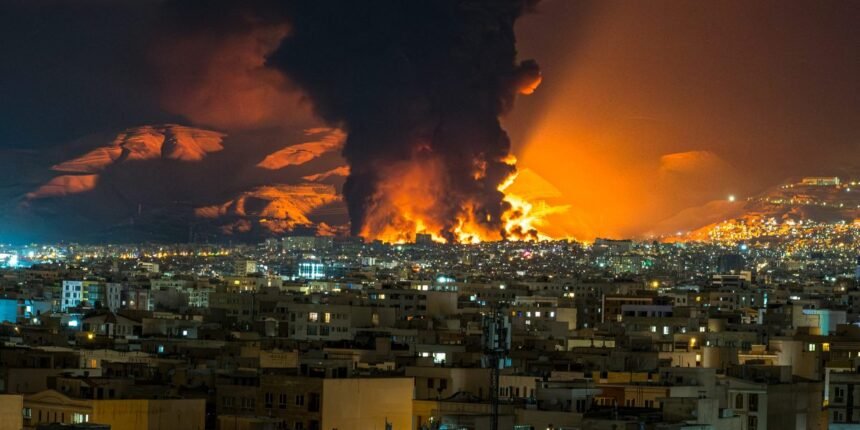
Despite these claims of already decimating Iran’s military, Iranian missiles continue to strike Israel with only hours, sometimes even minutes, between attacks, even as its barrages have become smaller. Every indication suggests war against Iran will not be quick like removing Nicolás Maduro in Venezuela. The country’s resolve is clear: When NBC News anchor Tom Llamas asked Iranian Foreign Minister Abbas Araghchi last week if he feared a potential American invasion, Araghchi replied, “No, we are waiting for them.”