The Guardline
The ceasefire announced Tuesday night by President Donald Trump and confirmed by Iranian officials is on life support. If Israeli Prime Minister Netanyahu gets his way, it may soon be dead.
Over the first 36 hours of the supposed ceasefire, hundreds have been killed and thousands injured in Israeli strikes on Lebanon. The attacks extended beyond Israeli’s traditional targets in southern Lebanon and Beirut’s outskirts into the central parts of the capital — and may mark the heaviest bombardment of the country since Israel’s 1982 invasion.
Trump suggested the ceasefire remains intact because Israel’s attacks are “a separate skirmish,” but the official announcement of the agreement described “an immediate ceasefire everywhere including Lebanon.” The language was put forward by Pakistan’s prime minister, who had brokered the deal and, according to the New York Times, the U.S. had seen the text before it was publicly released.
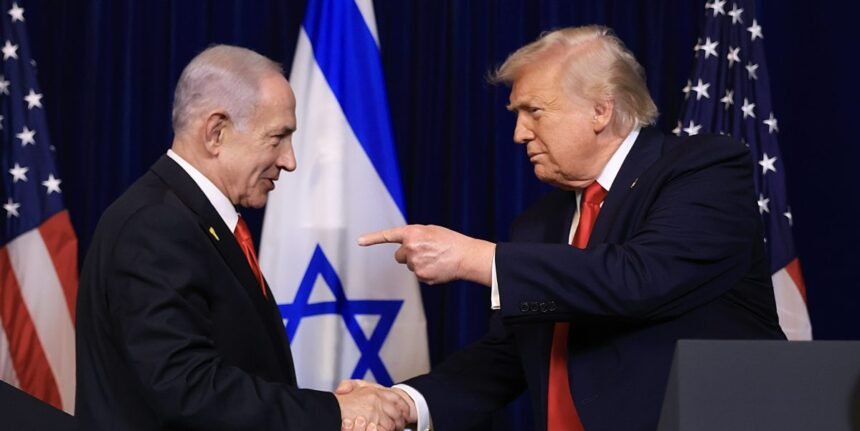
The words “including Lebanon,” however, lasted no longer than it took for Netanyahu to talk to Trump immediately before the ceasefire announcement. Trump confirmed Thursday that he told Netanyahu to “low-key it,” appearing to give Israel a green light to immediately violate the ceasefire and put it at risk of collapse.
In response, Iran says it will not open the Strait of Hormuz so long as Israel is violating the ceasefire. And planned talks in Islamabad for the U.S. and Iran to hammer out a longer-term agreement during the two-week ceasefire window have been thrown into doubt.
Netanyahu once said, “America is a thing you can move very easily.”
For his part, Netanyahu sought to dispel any notion that the Iran war was ending, emphasizing that the ceasefire is temporary and “a way station on the way to achieving all of our goals.”
When it comes exerting Israeli influence on the U.S., Netanyahu once infamously said, “America is a thing you can move very easily.” Indeed, according to reports, it was Netanyahu who convinced Trump to launch this war in the first place.
Now, potentially upending U.S. efforts to disentangle itself from conflict with Iran, the Israeli prime minister finds himself on familiar footing: playing the role of spoiler against any form of U.S.–Iran détente.
Decades of Détente-Busting
America’s supposed junior partner has worked ceaselessly to prevent any off-ramp from confrontation between the U.S. and Iran. In 1995, when Iran and the U.S. flirted with economic rapprochement by opening the Iran oil industry to American investment and development, Israel and AIPAC lobbied Congress and President Bill Clinton to block it.
In 2002, as Iran worked directly with the U.S. on Afghanistan in the aftermath of September 11, seeking a grand bargain, Israel interdicted a weapons shipment it said was bound for Palestinian forces, making questionable claims about the shipment’s Iranian provenance. The seizure helped tank the exploratory talks on Afghanistan and convinced President George W. Bush instead to infamously cast Iran as part of the “axis of evil.”
Over the course of President Barack Obama’s Iran nuclear talks from 2013 to 2015, Israel worked to block a deal — with Netanyahu engaging in unprecedented efforts to sabotage diplomacy. He even addressed a joint session of Congress against a nuclear deal over the White House’s objections. Ultimately, Netanyahu succeeded with Trump’s ascension: Under intense lobbying, Trump tore up the deal and nearly brought the countries to war before his first term ended.
Joe Biden campaigned on reentering the deal, but that aim was prematurely dispatched during Biden’s transition when Israel assassinated Iran’s top nuclear scientist in 2020, prompting Iranian hard-liners to pass legislation that blew up talks. When negotiations finally began in earnest in 2021, Israel launched an attack on Iran’s Natanz nuclear facility. Iran responded by announcing it would, for the first time, enrich uranium to nearly weapons-grade. The talks, predictably, failed.
Trump’s Second Term
Though Trump has proved to be a willing partner in Netanyahu’s push to increase tensions with Iran, Israel nonetheless now found ways to play the spoiler — much in the same manner it did with Clinton, Bush, Obama, and Biden.
These were not wars to defeat Iran, but rather wars to defeat U.S. diplomatic efforts.
The Israelis successfully turned two round of nuclear talks during Trump’s second term into cover for surprise attacks. Both the war on Iran in June 2025 and the current one were initiated not amid great diplomatic impasses, but when Iran put forward workable proposals. In both cases, U.S. officials said Israel was going to act regardless of the American position — and so the U.S. had to join the wars.
These were not wars to defeat Iran, but rather wars to defeat U.S. diplomatic efforts. They are the kinetic manifestation of Israel’s long efforts to keep the U.S. in a permanent state of war with Iran, sometimes cold, sometimes hot.
If U.S.–Iran talks do move forward and there actually is progress toward hammering out a sustainable cessation of hostilities, Israel will remain a wildcard. Any long-term ceasefire will require Israel’s acquiescence.
If Netanyahu tanks the ceasefire and the U.S. and global economy continues to suffer, Israel’s already plunging support among Americans is likely to falter even further. At this point, however, Netanyahu seems more concerned with his domestic political welfare than his credibility with American voters.
Netanyahu is widely thought to benefit from wars — from Gaza to Iran and now, most critically, in Lebanon — to shore up his political fortunes. He faces an election in October and losing could lead to the revival of corruption charges that might land him in prison.
The question now may unfortunately not be whether Iran and the U.S. can find a compromise. Instead, the fate of the global economy and, not least, Iranians themselves, could rest between Netanyahu and Trump, who faces his own political challenges in midterm elections this year.
It may once again be a question of whether it is America or Israel who blinks first.