The Guardline

When Federal Communications Commission Chair Brendan Carr talks about broadcast licensees serving the “public interest,” he loves to emphasize “localism.”
Localism is the idea that powerful entities (in this case, broadcasters) should serve the needs and interests of the communities they service. In the abstract, it’s hard to argue with, especially at a time when news deserts are spreading, small-town outlets are folding, and, thanks to the administration in which Carr serves, local public radio stations are reeling.
When you look at the fights Carr actually picks with broadcasters over the “public interest” requirement, however, a curious pattern emerges. They aren’t local stories at all, unless you consider Tehran and San Salvador local. They’re national and global stories that upset not residents of underserved heartland communities, but President Donald Trump, the man whose gilded face Carr wears as a lapel pin.
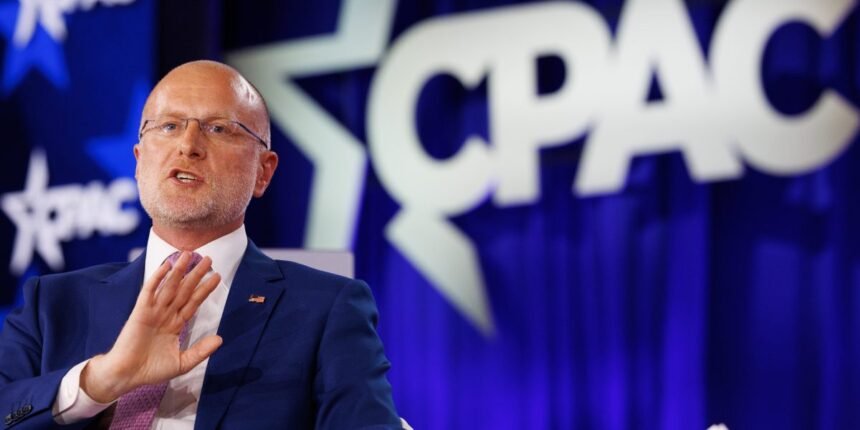
Sure, when he’s playing for the home crowd, Carr will openly admit, and even brag about, helping Trump reshape the national media to his liking. That’s what he did at the Conservative Political Action Conference on Friday, bragging about such “wins” as the Paramount–Skydance merger in Trump’s ongoing feud against media adversaries. Carr’s FCC approved that deal only after unconstitutionally extracting editorial concessions from CBS News and helping Trump launder a multimillion-dollar alleged bribe though the courts.
But in less partisan settings, from congressional testimony to mainstream media interviews, localism has become Carr’s go-to talking point whenever he’s pressed on his unconstitutional efforts to police news content or confronted with his past statements railing against the partisan suppression of news. He’s not censoring the airwaves, he claims; he’s just sticking up for the little guy.
Yet Carr has never threatened a broadcast license because a newsroom ignored city council meetings or local crime, or offered a biased take on a school board’s budget decisions. It would, of course, violate the First Amendment for him to do that too — the FCC, as Carr once said, “does not have a roving mandate to police speech in the name of the ‘public interest.’” But at least it would be consistent with his populist gimmick.
Let’s play back some of Carr’s greatest hits; see if you can spot the localism.
- When Trump complained that news outlets were running “fake news” about Iranian missile strikes, Carr warned that broadcasters running “hoaxes and news distortions” would lose their licenses if they didn’t correct course.
- After MSNBC declined to carry a White House briefing on the deportation of Kilmar Ábrego Garcia, Carr accused Comcast of ignoring “obvious facts of public interest” and warned “news distortion doesn’t cut it.” MSNBC (now MSNOW) is not a local outlet — it’s a cable station that the FCC doesn’t even regulate.
- Carr investigated KCBS, a San Francisco radio station, leading to rampant self-censorship in fear of retaliation. That might sound local, but the story that drew his ire was about a federal immigration enforcement operation. He didn’t care if the locals in the Bay Area wanted to know what immigration officers were up to — only that his boss does not want them to know.
- Carr investigated CBS over the same interview with then-Vice President Kamala Harris that Trump sued over, despite experts’ virtually unanimous agreement that the claims were frivolous. Then he helped Trump shake down Paramount for the aforementioned palm-grease by waiting until two days after Trump’s settlement check arrived to approve CBS parent Paramount’s merger with David Ellison’s Skydance. He touted that merger as proof of Trump “winning” his war on the media at CPAC.
- When Trump sued the BBC over a documentary about January 6, Carr wrote to the heads of PBS and NPR demanding transcripts and video of any American broadcast of the program, claiming the British broadcast about events in Washington, D.C., contained “news distortion.”
- After late night host Jimmy Kimmel commented on the assassination of Charlie Kirk, Carr warned that if ABC and Disney did not “take action” against Kimmel, the FCC would act. “We can do this the easy way or the hard way,” he said, drawing comparisons to mafia movies.
Carr also likes to tell broadcasters what they should air, but he doesn’t implore them to report more or better local news. Instead, he launched the “Pledge America Campaign,” calling on broadcasters to meet their public interest obligations by airing “patriotic, pro-America content” celebrating “the historic accomplishments of this great nation from our founding through the Trump Administration today.”
And in an expressly anti-local “public interest” intervention, Carr enthusiastically backed Trump’s directive to give the Army-Navy football game an exclusive broadcast window. Carr said in a press release earlier this month that “such scheduling conflicts weaken the national focus on our Military Service Academies and detract from a morale-building event of vital interest to the Department of War.” Because, of course, the hallmark of community broadcasting is not letting fans watch their local teams because the Pentagon needs a morale boost for its illegal, unpopular wars.
As a prior version of Carr knew, the FCC cannot police journalism for ideological bias. Localism is a Trojan horse Carr uses to legitimize his attack on the Constitution.
Nexstar is aggressively cutting jobs at flagship stations like WGN in Chicago and KTLA in Los Angeles, even as it lobbies for permission to expand further. Sinclair has decimated local newsrooms across the country, replacing them with centralized national programming — the exact opposite of the localism Carr claims to champion.
The real Brendan Carr is the unrepentant censorship czar who shows up at CPAC and openly threatens broadcasters on X, not the slicker version who rails against coastal elites to change the subject when questioned about his unconstitutional antics.
Carr is among the most shameless bootlickers (or Florsheim dress shoe-lickers) in an administration full of sycophants. The only localities whose interests he serves are the White House and Mar-a-Lago. He’s the last person who should be policing the “public interest,” locally or anywhere.