The Guardline
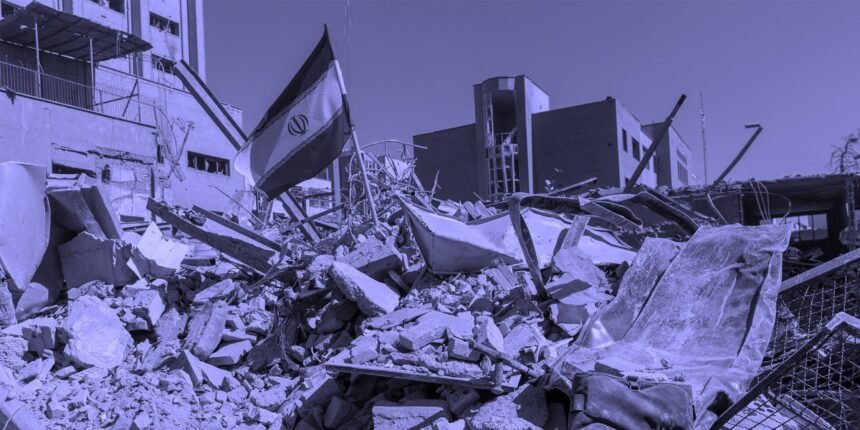
The Israel–U.S. military campaign in Iran has killed more than 1,000 people since the assault began on February 28. A war powers resolution in the Senate to curb President Donald Trump’s ability to drag the U.S. into the war failed on Wednesday. Similarly, a measure in the House failed on Thursday.
“This war is just a few days old and it’s escalating really quickly,” says Ali Gharib, senior editor at The Intercept. “It’s becoming a regional conflict,” as Iran retaliates and targets U.S. bases as well as Israel and Gulf energy sites. This week on The Intercept Briefing, Gharib discusses the human and political toll of the Israel–U.S. war on Iran with co-host Jordan Uhl and journalist Séamus Malekafzali, who has been based in Paris and Beirut.
“Trump has repeatedly failed to articulate anything even resembling coherent about why the U.S. got into this war,” says Gharib. He adds, “Marco Rubio even — who, again, not the sharpest tool in the shed, but usually has his shit pretty together — but in this case, he’s like changing his tune every two days because he has to keep up with Trump’s inanity about what the reasons for the war were.”
The end game for Israel here, says Malekafzali, is they want “a state that is incapable of defending itself, a state that is no longer sovereign.” He adds, “If you are bombarding police stations, if you are bombarding hospitals and schools, border guards, when you are attacking the very fabric of any society as your main target, CENTCOM and the IDF together, that means that you are going toward state collapse.”
“These are hard-won lessons over and over again for the United States — war after war, fallout, blowback. It just happens again and again. And yet we always seem to get leaders who are willing to run willy-nilly into these things,” says Gharib.
Listen to the full conversation of The Intercept Briefing on Apple Podcasts, Spotify, YouTube, or wherever you listen.
Transcript
Jordan Uhl: Welcome to the Interceptive Briefing, I’m Jordan Uhl.
Ali Gharib: And I’m Ali Gharib. I’m a senior editor at The Intercept.
JU: Today we’re going to talk about the growing war in the Middle East, specifically Iran. Last Saturday, Israel and the United States launched unprovoked attacks on Iran, and assassinated Supreme Leader Ali Khamenei as well as several senior military officials.
The Israel–U.S. strikes have continued on Iran, bringing the death toll to more than 1,000 people since the assault began. On Thursday, the World Health Organization verified 13 attacks on health infrastructure that killed four health care workers. Ali, it feels like we’ve seen this playbook run before, but this time, it seems like they’re trying to distinguish what is and what isn’t a war.
AG: This is like the sort of last readout of the idiot, when it comes to national security policy, is that you don’t need congressional approval. There’s no real stakes because this isn’t a war. This is part of a long history. It’s bipartisan. We’ve seen Democrats in office. We’ve seen Republicans in office. People are constantly starting these wars. They say they’re going to be limited strikes. Well, you know what? When you’re dropping bombs on another country and that country is attacking your military personnel in the area, that’s a textbook war.
In the so-called global war on terror, they could bullshit this and say, “Oh, we’re not going after armies. We’re going after these non-state actors and terrorist groups,” or whatever. But in this case, it’s like you’re literally attacking the leadership of another country and another country’s military.
There’s just no way to bullshit this. This is war. It’s what it is. There’s civilians dying. It’s the whole thing. It’s maybe the most egregious example since Vietnam of this phenomenon.
JU: Now there are efforts in Congress to rein in the Trump administration’s attacks on Iran. We will look to see how those votes develop, but I think there’s a general sense of pessimism around the outcome.
Another way of looking at it is just getting people on the record. Do you think that’ll be something that is an anchor around people’s necks going into the midterms?
AG: It looks increasingly like this is going to be a midterm issue. We’re seeing these breaks. In the Senate, it was pretty clean.
There was a war powers vote this week that failed and we saw [Sen. John] Fetterman, D-Pa., was the only Democrat to peel off, which isn’t that surprising. He voted last summer against a war powers resolution to block another Iran attack, which would’ve given Congress the power to stop exactly this calamity that we’re seeing right now. But it failed on basically party lines, with Fetterman defecting.
Then in the House there’s a version where we see some pro-Israel Democrats peeled off and tried to introduce their own version, which would allow Trump 30 extra days to continue the war before a congressional block gets imposed. We wrote about it this week on The Intercept. Our great D.C. reporter, Matt Sledge, wrote about it.
Because this is becoming a midterm issue, and these guys have to try and thread the needle here between satisfying their pro-Israel donors, satisfying the American voters who are not happy with this war, all told. And we’ve seen in some cases, some pro-Israel Democrats who were getting primaried from the left came out preemptively and said, I oppose this. And they’re still getting hit by their insurgent primary opponents for not having come out soon enough and hard enough.
This is something that Jon Stewart made a joke about this week, is that it seems like every time a president starts a war, Congress wants to come in next Thursday and do a vote about whether it’s authorized or not.
There’s logic to what these insurgent Democrats are saying is that we’ve known what’s going to happen here for a long time, and Democrats on Capitol Hill could not get their act together. And yeah, I think that some of these progressive insurgents that we’re seeing are going to make hay of that on the campaign trail.
JU: So there are many troubling things coming from this administration. The general sense is that they don’t have a clear objective or plan. We’ve seen people forward concerns in Congress, and especially in the anti-war camps. But then how the White House has been messaging on this — even down to their social media posts — has people deeply troubled.
There’s a video, for instance, from the official White House account that was posted on Wednesday that spliced together footage from “Call of Duty” — I would argue a military propaganda video game — with footage of actual strikes in Iran. This is that blurring of lines that critics of intervention and those games have been worried about for years because it sanitizes the act of killing.
We’re already distancing ourselves from direct combat through this unseen aerial warfare, and that is pushed to young people through these games. And now the White House specifically is pushing that. So I’m curious if you could touch on both of those things: the sanitization of war and the meaning of war, and also this lack of a plan.
AG: Honestly, I think those things go hand in hand that these guys — Trump, especially, you would think maybe Hegseth’s little military experience would be different, but I think maybe he’s a little too dull to really get what’s going on here — they just seem to not get the stakes that these are the most severe decisions that a government can make and that the stakes are really life and death, and not only just in the immediate dropping bombs, but long-term ramifications.
These are hard-won lessons over and over again for the United States — war after war, fallout, blowback. It just happens again and again. And yet we always seem to get leaders who are willing to run willy-nilly into these things.
On the one hand, they don’t take it seriously. It’s a political ploy. They think it’s a joke. They’re just like meme lords running around trying to goose up their base to get all hot and bothered about bombing some Muslims over there. Then on the other hand, they’re not taking it seriously in the actual war planning either. It’s not just the propaganda.
Watching Trump’s statements has been really incredible. To watch Marco Rubio even — who, again, not the sharpest tool in the shed, but usually has his shit pretty together — but in this case, he’s like changing his tune every two days because he has to keep up with Trump’s inanity about what the reasons for the war were.
Rubio came out and said the other day that he thinks their imminent threat was that Israel was going to attack and there was going to be blowback on U.S. assets in the region. That’s a maybe true but slightly embarrassing justification for war.
And then you had Trump who came back after he was asked about Rubio’s comments and said no, no, this happened because of me. We were negotiating with the Iranians over their nuclear program — which by the way, as the details have come out, it turns out they were, and there was huge progress being made. And then the U.S. bombed the shit out of Iran.
But Trump said these talks were going on and the talks weren’t going anywhere and were collapsing. (Again, bullshit.) And that he was worried that that would spur the Iranians to attack — for which there is no evidence. Something Iran has never done in the history of the Islamic Republic is lash out after a diplomatic exercise like that has failed. I’ve covered this for my whole career: There’s been a lot of diplomacy that’s failed, and Iran is never so much as hinted that they’re going to then lash out afterward. That became Trump’s excuse. It’s these constantly shifting goalposts.
“Something Iran has never done in the history of the Islamic Republic is lash out after a diplomatic exercise like that has failed.”
Not only is there no clear justification, there’s no clear end game here. This is something I’ve talked about a lot, and I spoke with Séamus Malekafzali today on the podcast about it. He’s a journalist who writes about the Middle East, with a strong focus on Iran, and he’s been based in Paris and Beirut. We went through some of this stuff about the U.S. haplessly walking its way through this war, and the Israelis just don’t care what happens. And for them, a failed state is great. We’ve seen comments to this effect from Israeli analysts that are close to the military–industrial complex there. They just seem to have dragged Trump into this thing that Trump has haplessly, just buffooning his way through.
JU: Let’s hear that conversation.
AG: Hey Séamus, welcome to the show.
Séamus Malekafzali: Happy to be here.
AG: The pleasure is all ours, Séamus. So today we’re going to be talking about the biggest story in the world right now: Israel and the U.S. launched an unprovoked attack against Iran last Saturday. It’s still going on. Iran’s Supreme Leader Ali Khamenei was assassinated, so were a bunch of top regime figures — people from the Iranian Revolutionary Guard Corps, other military leaders.
It’s been a pretty violent conflict so far. Hezbollah, the Lebanese Shia group that’s closely aligned with Iran, lobbed a few missiles into Israel. Israel, in retaliation, began seizing territory in southern Lebanon.
There’s a new wave of strikes on Iran, and U.S. Defense Secretary Pete Hegseth has said that we’re “just getting started.” This war is just a few days old, and it’s escalating really quickly. It’s spiraling out of control. It’s becoming a regional conflict. Does that sound about right to you, Séamus? Is this moving into a much more dangerous situation really, really fast?
SM: I would agree with that estimation, yes. Trump had said that he was surprised by this, but Iran had threatened to bring all these different Gulf Arab countries that are hosting American bases into the war, and they did that immediately once Israel and America launched their strikes.
Recently, they had even struck Oman and potentially even oil fields in Saudi Arabia against the advice of the civilian Iranian government. Apparently, there has even been an attempt to strike at a base inside Turkey that had been hosting American forces. I’m unsure of what the Iranian government has said about that matter, but I imagine they are not keen on Turkey being one of those targets. But because of the decentralized nature of the Iranian military, they had been given instructions to expand this without individual authorizations by the Iranian leadership.
AG: You mentioned the expansion of the war. I think that that’s a really salient point about the decentralized leadership and in fact that’s become an essential directive for the Iranians because they’re just being so closely surveilled and any communications they have could potentially give away locations and they’re running tremendous risks.
It seems like the Israeli intelligence, to your point, is extremely good on these targets that it’s hitting. So it’s hard to imagine that when the targets get so broad or say, a girls’ elementary school gets hit in southern Iran, that these sorts of things are just terrible mistakes. Like, no, this is the nature of having a wide-scale conflict and I think we should be skeptical of claims of just that things go errant.
There was this attack on Mir-Hossein Mousavi’s residence early on in the war, I think, on the first day of strikes. We’re talking about an opposition leader here who’s been under house arrest. A lot of apologists will claim that was an accident, but it’s not clear that it was. And then we see Trump complaining about there being nobody to take the place of the Iranian leadership. It stretches credulity when you put together all the statements.
SM: When Pete Hegseth says that they are investigating the strike on that elementary school for girls in Minab, and then they throw up on the screen a map of all these different strikes that CENTCOM has done — and Minab is right there, that school. They obviously know what they did. They’re covering that up, that fact.
On the Mousavi front, I’m unsure of the nature of that strike. I know that Mousavi’s apartment was near Pasteur, where all these different Iran government ministries are located. But [former President Mahmoud] Ahmadinejad was apparently someone who at least a strike happened in his area. He appears to be alive still. There were reports of his death but he apparently communicated to Patrick Bet-David, an American Iranian podcaster, that he was still alive. But nevertheless, Itamar Ben-Gvir went out and said that Ahmadinejad was a righteous victim of the Israeli military
AG: Just for context, Ahmadinejad was the president of Iran, obviously, in the late 2000s and early 2010s, but also a figure who in recent years has fallen deeply out of favor with the Iranian government. I don’t know if I’d go so far as to call him an opposition leader. But certainly not somebody who has a hand in anything the government is doing these days.
SM: No, no, no. He is very much on the Supreme Leader’s shit list. They are not keen on leaving any sort of leadership of any kind, I think, if the strike near Ahmadinejad is intentional, which I still have doubts about.
Trump had seemed to be confused about the nature of the temporary leadership council that took power after Khamenei was killed, that apparently there were second or third choices that may have been also killed, but also those three he might’ve had something to gain from them.
Then the reports that they wanted the IRGC, some aspect of them that could take over, be friendly to the United States. No, there’s no actual plan for any of this. In the same way that when Maduro was abducted and taken here to New York City that Delcy Rodriguez was the person who they were going to threaten and then have take power.
There is no parallel figure within the Iranian government, which means that they are pushing things towards state collapse, rather than trying to position an America-friendly, Israel-friendly Iranian government in power.
AG: Or even just in the Venezuela case, an alternative who might be compliant.
SM: Exactly.
[Break]
AG: Obviously, Israel has been a major player in this war. There’s been enough talk, at least, about Israel having pushed Trump into the war that Trump got asked about it and gave a pretty defensive answer.
Donald Trump: No, I might have forced their hand. We were having negotiations with these lunatics, and it was my opinion that they were going to attack first. They were going to attack if we didn’t do it.
AG: Israel has just become a rogue actor in the region. It’s constantly unleashing these military assaults. The lesson learned from Gaza was that there’s not going to be any accountability for anything that the Israeli government does.
“The lesson learned from Gaza was that there’s not going to be any accountability for anything that the Israeli government does.”
Obviously, more than 70,000 people killed in the genocide there. Since the so-called ceasefire, Israel has killed 600 more people in Gaza. There’s been allegedly thousands of violations of the ceasefire between Hezbollah and Israel before this latest war with Iran started. And those are documented by the U.N. peacekeeping forces. These aren’t like Hezbollah numbers or anything.
Now after the attack on Iran, we see the war expanding in Lebanon. You lived in Beirut, obviously, you know this terrain very well. Do you have any sense of what the mood is like there?
SM: There is definitely been a difference in tone from this intervention than the intervention that happened after the war broke out against Gaza in 2023. Having a war for Palestine, regardless of the sympathies that a lot of Lebanese had for Palestinians, they never largely wanted to get involved in a war on Lebanese soil for Palestine.
There isn’t polling on such an immediate thing. Even if Hezbollah is responding to 15 months of unchecked Israeli aggression against Lebanese territory which they did phrase in their statement — and also the fact that they were apparently, according to Israeli reporting, even preempting an Israeli preemptive strike on Lebanon — the optics of doing this in retaliation for Khamenei’s death, that being the express logic that was said in their statement that has presented problems that Hezbollah is not — They’re in a very difficult situation, an impossible situation, an unenviable situation. But this has not gone the direction that it had after 2023.
The Lebanese government has begun arresting members of Hezbollah and also some Palestinians who have been traveling down to the south. Amal [Movement], their closest ally in politics, has begun splitting in some regards. I have heard reports that Amal locals on the ground are participating in the offensive, but the party leadership is now more at odds with Hezbollah than it had been in the past.
The Lebanese government is not in the position in which it can allow this to happen. It is happening on their own volition. They’re making that decision expressly. But the impunity that Hezbollah had to act unilaterally without the permission of the Lebanese government — that still exists, in that they have military capabilities outside of the military, but the Lebanese government is clearly acting to stop Hezbollah’s retaliation from going on in a way that they were not after October 7th.
AG: And this is another example of the fracturing politics of the region over the past couple years, and especially in the past few days here in the Middle East. You mentioned earlier, the Gulf Arab neighbors of Iran and what this war has meant for them. We’ve seen reports repeatedly of energy infrastructure being hit. Some of that maybe is debris starting fires that are from intercepted missiles. It’s very unclear what’s being targeted, what’s being hit.
We know that in some examples there have been instances of civilian infrastructure. A luxury hotel in Bahrain got hit by Iranian missiles or maybe a drone and got severely damaged. There was an Iranian official who actually told Drop Site News that they had gotten intelligence that there were American war department officials in there.
The Washington Post got a hold of a State Department cable back that said yeah, two Pentagon officials were injured in that strike on the Bahrain hotel. So it does seem that the Iranians are going after some legitimate targets when they’re buried. Abbas Araghchi, the foreign minister, has said that the Americans, when their bases started to get hit, dispersed their assets and people moved into civilian areas and that’s what they’ve been going after. For us, a lot of that stuff is extremely difficult to check.
SM: Yeah.
AG: This war is really remaking the Gulf Arab countries’ images as well.
SM: Yeah, and I don’t think they’re prepared for it at all. There was an Iranian parliamentarian, I think the head of the Parliament’s National Security Committee, that had said that the purpose of these strikes is to have these countries evict the Americans. The Gulf countries — I assume, I can only assume — they hosted these bases because of an assumption of American protection or American support if Iran were to launch this kind of attack against them. And there has been absolutely no American protection or real support, in the few ways that it has manifested. When American [F-15] fighter jets were taking off from Kuwait, three of them apparently got shot down by a single Kuwaiti jet that obviously was not anticipating being involved in this kind of conflict.
There was a perception that these were places that were somehow outside of politics, despite being inside the Middle East next to Iran and very much close to Israel. I think it’s going to take many years for that to be repaired — if it will ever be repaired — because these countries have never suffered this kind of conflict.
Saudi Arabia has suffered through this. Iraq has suffered through this. Kuwait has suffered through this. But Qatar, Bahrain, the UAE. Like, even singular ballistic missile launches from the Houthis, or that drone that hit Abu Dhabi airport some years ago. Those were things that had to be covered up and rapidly ignored in order to maintain that image. It can no longer be ignored in this. It’s far too wide-ranging.
“There was a perception that these were places that were somehow outside of politics, despite being inside the Middle East. … I think it’s going to take many years for that to be repaired.”
AG: And the reverberations aren’t just limited to that. Can you talk a little bit about what this is doing to energy markets — Iran’s strategy closing down the Strait of Hormuz, and this “bringing a cost to this conflict for others” strategy that Iran’s using, with regards to energy moving out of the Gulf?
SM: Qatar supplies 20 percent of the global output of energy, and they have shut down most of their production.
AG: LNG specifically, I think is their 20 percent, liquid natural gas.
SM: Clearly a massive shock is on its way. Iran had hit an oil platform in Fujairah. Aramco had come under attack in some capacity by the Iranian military, a field in Saudi Arabia. Strait of Hormuz — I had seen some bizarre graph from somebody on Twitter where they showed all of the traffic in the Strait of Hormuz absolutely tanking, and then they created some sort of projection line where it all went back up after five days. I do not think that it’s going to happen.
Oil prices are already starting to shoot up, not overwhelmingly so, but they’re starting to shoot up. There were predictions made that by next month, gas prices could be up more than a 100 percent, perhaps even near 130, 140, 150 percent in Europe. For Americans, I imagine would be in a similar boat, gas prices that are higher than they were during the financial crisis — $5 a gallon, even higher than that.
That is the lever that Iran is rapidly trying to pull up and down because it knows that it is the only one that truly affects the decision making in the West. Any sort of anti-war sentiment that exists in these places, it is not going to be able to move any of these officials. What is going to move them is if people are feeling this in their checkbooks at the pump, when it becomes so costly to continue executing this that they have to pull back or else it becomes prohibitively expensive.
Oil “is the lever that Iran is rapidly trying to pull up and down because it knows that it is the only one that truly affects the decision-making in the West.”
AG: And I should note that the Aramco thing also remains a mystery because the Iranians did explicitly deny that. I thought that was curious. They said that, no, we’re not targeting Aramco, which I thought was interesting. It’s not necessarily true, but just that they haven’t been shy about some of the stuff they’ve been targeting, but that one they did deny.
So working the levers that these foreign governments will listen to and the way to put pressure on them that is broader than just an anti-war movement — do you have any thoughts on what this pressure means in the U.S. and the kind of fractures that we’re seeing? Is Trump susceptible even to these kinds of things? Or is he just in his own world enough where so far it seems like he’s committed to keeping going and just living in his own fantasies?
SM: I don’t think Trump is susceptible to public opinion. He cares about it to a certain extent, but he really just wants to be seen more than anything as a deals man. A deals man does not allow this kind of thing to go for months, if not years. He wants the perception that he can do that for as long as he wants, but this cannot follow him forever. He wants to focus on other things. He wants to be seen as somebody who is making peace, somebody who is getting things done quickly. And if that image is not true in a severely obvious way, that is something that he does not want to be associated with — either in government or by the public.
AG: His partner in all this, of course, who, again, maybe has dragged him along into some of it, was Benjamin Netanyahu. In a way Trump has repeatedly failed to articulate anything even resembling coherent about why the U.S. got into this war. But Netanyahu has been forced on American TV on Sean Hannity’s show to make the case for going to war in Iran. And let’s listen to a clip of that.
Benjamin Netanyahu: After we hit their nuclear sites and their ballistic missiles program, you’d think they learned a lesson, but they didn’t because they’re unreformable. They’re totally fanatic about this, about the goal of destroying America.
So they started building new sites, new places, underground bunkers that would make their ballistic missile program and their atomic bomb programs immune within months. If no action was taken now, no action could be taken in the future. And then they could target America. They could blackmail America.
AG: All right, Séamus, you and I know that this is a lot of the same bullshit we’ve been getting for a while and there’s a lot to unpack here. But the thing I’d like you to talk about, if possible, is some of these claims that we’ve been seeing that, within months, Iran would be immune and have the bomb for 20 years now.
Then also this war coming right in the middle of negotiations over exactly these issues between the U.S. — in direct negotiations, I should say — over exactly these issues between the U.S. and Iran that were being led by Trump’s envoys Steve Witkoff and Jared Kushner. If you could talk about the context of Israel starting this war at this very moment.
SM: Jared Kushner and Steve Wikoff, I believe that these are diplomats, but they’re not actually diplomats. I mean, in a real sense, they are diplomats in that they’re real estate moguls — one a little bit more successful than the other. But these are not people who have any sort of diplomatic skill.
They are there to enforce an ideological line and extract concessions without any sort of expectation of concessions on their own part. This is why I think they were so favored by the Israeli government because there was no actual negotiating going on. It was deception. Explicitly, it was deception by these two people.
When America is sending negotiators to your country and demanding not only the cessation of your nuclear program, the taking of all of your enriched uranium and sending it directly through the U.S. who promises we’re going to send you nuclear fuel for your own civilian plants, but we get to control everything. But also apparently, according to Witkoff on Hannity, a few days ago, he had said that they even asked for Iran to eliminate its own navy so that America would have eternal freedom of operation in the Persian Gulf and the Strait of Hormuz.
They are effectively Israeli agents in this regard in that they are supporting a maximalist Israeli-led position, and they are very much supported by the Israeli government in this regard.
AG: What is Netanyahu’s end game here? What is the Israeli objective? Is this what you were talking about with state collapse being the direction we’re going? Is that the actual end game or is that just where we’re going?
SM: I think that is the actual end game. Look, Trump, I’m sure there will be discussion soon about resource extraction or getting something from the Iranians or wanting a friendlier government. That’s something that Netanyahu has said as well. But the things that are being demanded of Iran — that being no ballistic missiles at all, no navy — the basic thing that you would have as a country. What they want is a state that is incapable of defending itself, a state that is no longer sovereign, and a state that cannot exercise these abilities is a state that does not exist, fundamentally.
If you are bombarding police stations, if you are bombarding hospitals and schools, border guards, when you are attacking the very fabric of any society as your main target, CENTCOM and the IDF together, that means that you are going towards state collapse. And that even if you are supporting in the future some group that may come up — or maybe [Reza] Pahlavi or this Kurdish [group], anything, doesn’t matter — the state that will eventually emerge is a state that has been stripped of its ability to do anything resembling a state. It will be a subdued state, either as severe as Gaza, even if Israel is not going to settle or depopulate Iran, or a state that is subdued like Lebanon, in which it has to listen to the directives of Israel and America for it to continue functioning in any capacity.
Then in the regional picture, these weakened and failed states have been pretty good for Israel in terms of eliminating threats. You said that you think Trump envisioned some kind of deal or maybe some sort of future benefit, and he’s going to start talking about that stuff. Do you think he quite understands what’s going on here?
SM: No. I’ll speak very plainly, no. The way in which Iran has been spoken about in Republican circles for a very long time is that Ali Khamenei, the supreme leader, is a personality figurehead, and the entire government is based around his power, and when he falls, the entire Islam Republic will fall. If you take him out, then all the dominoes start falling immediately.
This was false. It has been false. Khomeini died, and Khamenei was elected to the deposition by the assembly of experts and the government did not collapse even though Khomenei took a much larger position within the Iranian political world, within Iranian society.
[Trump] does not seem to have any understanding of the different institutions that have influence within the country. He listens to what his advisers tell him about what people might be friendly to him or might want to deal, and he internalizes some of it. But he does not have an actual understanding of how the country works, how any sort of cultural forces might be working, anti-imperialism how that might inform other people’s decisions; how these people might feel like they have their backs against the wall, and that might inform their thinking that maybe they don’t want to be killed or made into a puppet. He fundamentally does not understand the country, not in a political sense in that Iran is some sort of brave and unsubdued power that is capable of anything, but that it is a country that does not function like Venezuela — even Cuba, as he envisions it.
AG: That’s pretty sound analysis given what we know about him. Séamus, thank you so much for taking the time to talk to us. It’s a pleasure to catch up with you and get your thoughts on what’s going on. You’re an experienced reporter who spent some time in the region, and I greatly appreciate your perspective.
SM: Thank you. Anytime.
JU: That was Ali Gharib, The Intercept’s senior editor and Séamus Malekafzali, a journalist and writer covering the Middle East.
That does it for this episode.
This episode was produced by Laura Flynn. Ben Muessig is our editor-in-chief. Maia Hibbett is our Managing Editor. Chelsey B. Coombs is our social and video producer. Desiree Adib is our booking producer. Fei Liu is our product and design manager. Nara Shin is our copy editor. Will Stanton mixed our show. Legal review by David Bralow.
Slip Stream provided our theme music.
This show and our reporting at The Intercept doesn’t exist without you. Your donation, no matter the amount, makes a real difference. Keep our investigations free and fearless at theintercept.com/join.
And if you haven’t already, please subscribe to The Intercept Briefing wherever you listen to podcasts. Do leave us a rating or a review, it helps other listeners to find us.
Let us know what you think of this episode, or If you want to send us a general message, email us at podcasts@theintercept.com.
Until next time, I’m Jordan Uhl.