The Guardline
RAMALLAH — Traffic was at a standstill outside of Nablus in the occupied West Bank on Saturday, as sunset neared and hungry residents were forced to trickle through an Israeli checkpoint to get home and break their fasts.
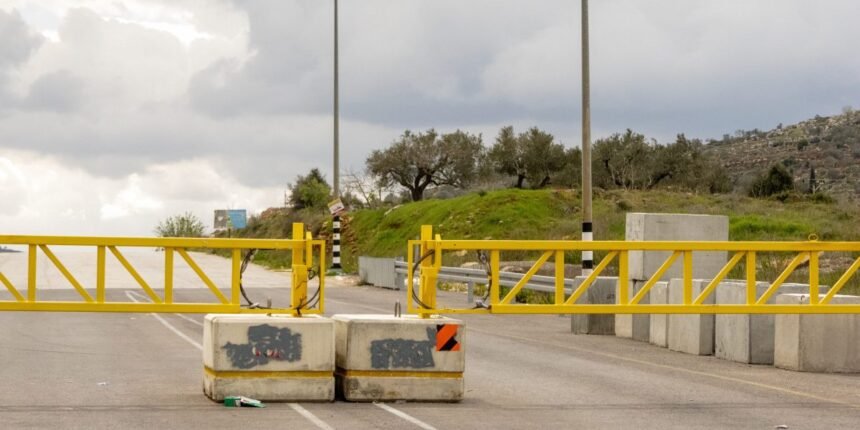
The Israeli military had sealed the city off from the outside world. Just over a week after the U.S. and Israel launched their joint war on Iran, Israeli settlers have ramped up their violence against Palestinians in the West Bank, and Israeli forces have imposed a near-total closure of municipal centers, shutting gates and restricting crossings without warning or perceptible logic.
“It’s so unpredictable,” said Shadya Saif, 40, a Palestinian mother of three who teaches at a private school in Ramallah. The Intercept rode alongside Saif as she traveled back to Ramallah from Nablus on Saturday, when the Israeli military closed all but one checkpoint out of the city, putting it under an effective blockade and forcing all traffic through a checkpoint called Shavei Shomron.
The unannounced closures left Palestinians scrambling. Many were visiting Ramallah to see family members during Ramadan, and they hoped to reach their destinations in time for iftar, the fast-breaking meal enjoyed at sunset. Others needed to enter the city to receive medical treatment they cannot obtain elsewhere. Saif had risked the journey to see her dying uncle and, knowing the risks of crossing, she’d left her chronically ill daughter in Nablus with him.
“I was worried I would get stuck here,” Saif told The Intercept inside a yellow “service” taxi, the only form of public transportation widely available in the West Bank. Even though nearly all of her family lives in Nablus, she has tried to avoid visiting since October 7, 2023, after which the Israeli military clamped its ubiquitous yellow gates over entry points throughout the West Bank.
Israeli soldiers stopped each car to inspect Palestinians’ IDs. At their limit, drivers began pulling their cars onto roundabouts and driving the wrong way down the street, but the final say lay with Israeli forces, who allowed only one car at a time to approach the military installation. Some abandoned their cars to walk through checkpoints and reach their families on foot. An elderly Palestinian woman prayed aloud, saying that all she wanted was to make it safely to her family in Ein Yabrud, a village on the outskirts of Ramallah.
“I was worried I would get stuck here.”
As we sat waiting at the checkpoint, Saif’s face was filled with worry. She opened her phone to show pictures of her daughter, dressed in pink and smiling at the camera.
Saif’s daughter has muscular dystrophy and requires specialized treatment and 24-hour supervision. Saif took a big risk visiting Nablus to see her dying uncle in the hospital, she said, because if she were to get stuck there due to a checkpoint closure — which did happen for three days last week — her daughter’s health would be put in jeopardy.
“I left her with my uncle just for the day, but I have to be there to care for her,” Saif said. “I know her medications and how to ensure she doesn’t get sick.”
Saif made it back to Ramallah, but she said it would not have been possible a few days earlier.

The day after the U.S. and Israel started attacks on Iran, the prevailing sentiment in Ramallah was anxiety. People wondered if there would be road closures and food and fuel shortages like during last year’s Twelve Day War, and whether the Israeli government would impose what Palestinians describe as collective punishment in the West Bank, even though they were not involved in the conflict.
“It has nothing to do with anything Palestinians in the West Bank are doing or not doing,” said Aviv Tatarsky, who leads an Israeli protective presence collective that organizes watches to deter settlers from invading Deir Istiya, a village outside Ramallah. “And still, there’s an Israeli decision, and life comes to a stop.”
“There is no money, no work. We are in debt, and I have four mouths to feed. What am I to do?”
Ramallah, which has long functioned as a relatively insulated bubble from the effects of Israel’s occupation, is also dealing with a struggling economy. Paired with the war, the economic downturn has muted Ramadan celebrations, according to residents who spoke with The Intercept.
“We are suffering,” said Faisal Taha, who drives taxis in Ramallah. “There is no money, no work. We are in debt, and I have four mouths to feed. What am I to do? I have been driving my taxi all day, and I have forty shekels.”
Unemployment in the West Bank is hovering around 40 percent — up from 13 percent two years ago — and GDP has contracted by 13 percent since October 7.
Dror Etkes, founder of Kerem Navot, an Israeli NGO that monitors settlement construction in the West Bank, said he was not surprised by the restrictions imposed by Israel.
“They always use instances of violence to perpetuate more violence,” Etkes said. “This is what we have seen for years, since October 7, and now it is worse than ever.”
As during the Twelve Day War last year — after which Prime Minister Benjamin Netanyahu declared a “historic victory” that would “stand for generations” against the Islamic Republic of Iran — there are already the beginnings of flour and fuel shortages in the West Bank as the Israeli Civil Administration, which runs the military occupation of the territory, imposes import restrictions.
“This is not something new. It happened in June during the Twelve Day War, and it’s kicking off again,” Tatarsky said. “But what’s different this time is that Israel is also blocking roads — not only disconnecting Palestinians from Area C, but also blocking roads between Palestinian villages.”
A week later, on March 7, there was still only one checkpoint out of Ramallah open, forcing all traffic through a bottleneck that passes by the Beit El settlement and through the Jalazone refugee camp. This is the only route for Palestinians living in Ramallah to access Route 60, the main thoroughfare connecting Palestinian communities in the south to those in the north.
“They always use instances of violence to perpetuate more violence.”
Driving up the highway and passing village after village that had been closed off by the Israeli military, Etkes said it was clear the war with Iran was being used as a pretext for “a system that is meant to reduce as much as possible the area where Palestinians can move freely,” part of the settlement movements’ goal to alter the facts on the ground regarding de facto annexation.
Nabih Odeh, 63, who has been driving public transit taxis in the West Bank for more than 30 years, has watched what he describes as the slow annexation of the West Bank unfold. As he drove up Route 60, he pointed to village after village sealed off by the Israeli military.
“There, that’s Aqraba, closed,” Odeh said. “If you want to get in or out, you must walk. That’s Turmus Ayya — very wealthy — still closed.”
Eighty percent of Turmus Ayya’s residents have U.S. citizenship, yet the town was closed off, its yellow gate locked. Service taxis pulled up to drop residents off, leaving them to walk to the town center or be picked up by relatives. Its status as a wealthy American Palestinian village has no bearing on Israel’s decision.
At the same time, Israeli settlers have used the war with Iran as an opportunity to launch further attacks on Palestinian communities, largely in Area C — the roughly 60 percent of the West Bank under full Israeli civil and military control — working in tandem with movement restrictions in Areas A and B, the Palestinian-administered population centers and villages created under the 1995 Oslo Accords.
Messages circulating in settler WhatsApp groups have called for violence against Palestinians to match Israeli airstrikes in Iran. One graphic depicting a roaring lion, to match the Israel Defense Forces’ name for the military operation against Iran, reads: “It is time to launch a preemptive attack in all arenas, until the enemy is expelled from the country and subdued outside it. This time we win, once and for all.”
“I mean, generally, when you’re speaking about Israeli society, it is torn apart in so many ways,” said Orly Noy, editor at Local Call and chair of B’Tselem’s executive board. “But there’s one thing that always unifies, and I’m speaking about the Jewish section of society, of course, and this is war.”
Netanyahu is willing to do anything to stay in power, Noy added, and during his time in office, he has worked effectively to paint the Iranian regime as an existential threat to Israel, working in tandem with the U.S. “He has taken advantage of it very well,” Noy said.
During Operation Rising Lion, this rally-around-the-flag effect has not only served Netanyahu’s interests but also those of settlers living in the West Bank.
WAFA, the Palestinian Authority’s news agency, estimates that settler attacks have increased 25 percent since the start of the conflict. Israeli settlers have killed six Palestinians since the start of the war with Iran, including three in one incident in the West Bank community of Khirbet Abu Falah, east of Ramallah.
Israeli settlers shot Fare’ Hamayel and Thaer Hamayel, and a third man, Mohammad Murra, died of suffocation from tear gas deployed by Israeli forces.
As the world’s attention remains on Iran, solidarity activists said that Israeli settlers appear to feel they have additional impunity to conduct attacks.
“They will be treated as heroes by their supporters, by their society,” Etkes said. “And the government will do nothing about it.”